Diffraction and two-point interference
Key ideas
Diffraction is the spreading of waves as they pass through a gap or around an edge. Interference is the pattern of loud/quiet (or bright/dark) regions produced when waves from two sources overlap.
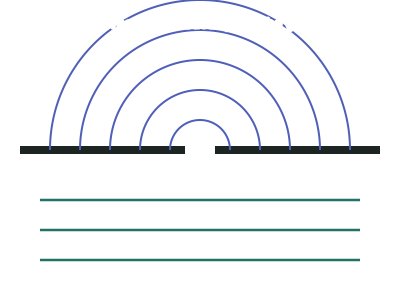
Diffraction through a slit
- Waves passing through a gap spread out into the region beyond it.
- The amount of spreading depends on the gap width compared with the wavelength:
- Gap similar to the wavelength → lots of spreading.
- Gap much wider than the wavelength → little spreading.
- Diffraction does not change frequency, wavelength or speed — only the shape of the wavefronts.
Two-point source interference (qualitative)
- Two sources sending out waves in step (in phase, same frequency) overlap to give a fixed pattern.
- Constructive interference — waves arrive in phase (crest meets crest). This happens where the path difference is a whole number of wavelengths:
- Result: large amplitude — a loud spot (sound) or bright fringe (light).
- Destructive interference — waves arrive out of phase (crest meets trough). This happens where the path difference is a half-odd number of wavelengths:
- Result: small or zero amplitude — a quiet spot or dark fringe.
:::tip "Path difference" means how much further the wave from one source travels to reach a point than the wave from the other. If a point is the same distance from both sources, the path difference is zero — always a constructive (bright/loud) point. Start there when explaining a pattern. :::
Two loudspeakers play the same m wavelength sound in phase. At point P, the sound from one speaker has travelled m further than the sound from the other. Is P loud or quiet?
Step 1 — Compare the path difference with the wavelength
Step 2 — Decide the interference type
A path difference of half a wavelength means the waves arrive out of phase — crest meets trough.
Practice question
Two sources emit waves of wavelength m in phase. At point Q the path difference is m. Is Q a point of constructive or destructive interference?
Worked solution: whole wavelengths, so the waves arrive in phase → constructive (loud/bright).
Test yourself
Practice by grade
One question each at Achieved, Merit and Excellence. Have a go, then compare with the model answer.
Water waves pass through a gap in a barrier and spread out on the far side.
Name this effect and state one factor that affects how much the waves spread.
Two speakers emit sound of wavelength m in phase. At a point, the sound from one speaker travels m further than the sound from the other.
Determine whether this point is loud or quiet, showing your reasoning.
A student narrows the gap in a barrier that plane water waves pass through. Explain fully how and why the pattern of waves beyond the gap changes as the gap becomes about the same width as the wavelength.