Perfect competition in the long run
What the long run means
- The long run is the period in which all inputs are variable, so firms can enter and leave the industry.
- In perfect competition there are no barriers to entry or exit, so nothing stops them.
- That single characteristic drives the entire long-run result.
The adjustment from supernormal profit
Write this as a chain — the Assessment Report supplies almost exactly this wording as the model answer:
- Firms are making supernormal profit in the short run: P > AC.
- Because there are no barriers to entry, new firms are attracted into the industry by that profit.
- More firms means market supply increases — the market supply curve shifts right.
- With demand unchanged, the market price falls.
- The individual firm's horizontal MR = AR = D line shifts down.
- Firms keep entering as long as any supernormal profit remains.
- Entry stops when the price has fallen to the point where P = AC and only normal profit is made. There is now no incentive for any further firm to enter.
The adjustment from a loss
The mirror image, and the report's own example:
- Firms are making subnormal profit: P < AC.
- Because there are no barriers to exit, loss-making firms leave the industry.
- Fewer firms means market supply decreases — the supply curve shifts left.
- The market price rises.
- The firm's revenue line shifts up.
- Exit continues until the price has risen to P = AC and the remaining firms make normal profit.
The long-run equilibrium
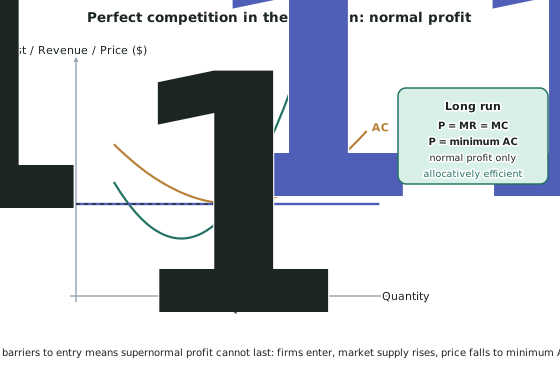
- The firm's horizontal revenue line is tangent to the bottom of the AC curve.
- Because MC also cuts AC at its minimum, three things happen at the same point:
P = MR = AR = MC = minimum AC
- Normal profit only. P = AC, so no supernormal profit and no loss.
- Allocatively efficient. P = MC, so the value of the last unit to a consumer equals its cost of production.
- Productively efficient. The firm produces at minimum AC, the lowest possible cost per unit.
Why this is the benchmark for the whole standard
- The standard's own words: perfectly competitive firms "operate at the profit maximising output where P(=MR) = MC and are allocatively efficient".
- Every judgement about a monopoly in this paper is a comparison against this position.
Worked ExampleThe long-run adjustment
An illustrative perfectly competitive market for a food product is currently at a price of $9.00 per unit. At that price a typical firm produces 6,000 units at an average cost of $7.00.
The minimum of the firm's AC curve is $6.00 per unit, at an output of 5,000 units.
Explain what will happen in this market in the long run, and describe the final position of the typical firm.
Step 1 — Identify the starting position
At $9.00 the firm produces 6,000 units where P = MC, and average cost is $7.00.
P > AC, so the firm is making supernormal profit:
profit per unit = 7.00 = $2.00 total supernormal profit = $2.00 × 6,000 = $12,000
Step 2 — Why this attracts entry
There are no barriers to entry in a perfectly competitive market. Existing profits are visible to everyone because there is perfect information, so the $12,000 supernormal profit signals to firms outside the industry that they could earn more here than in their current use.
New firms therefore enter the industry.
Step 3 — What entry does to the market
Each new firm adds its output to the market, so market supply increases and the market supply curve shifts right.
Market demand has not changed. With a larger supply and the same demand, the new market equilibrium is at a lower price and a larger total market quantity.
Step 4 — What that does to the individual firm
The firm is a price taker, so its horizontal MR = AR = D line shifts down with the market price.
As the price falls, the point where the price line crosses MC moves down and to the left, so the firm's individual output falls. Its supernormal profit shrinks from both directions: the gap between P and AC narrows, and the quantity falls.
Step 5 — Where entry stops
Entry continues for as long as any supernormal profit remains, because as long as P > AC there is still a reason for another firm to enter.
Entry stops when P = AC, at which point firms make normal profit only and there is no incentive for anyone else to come in.
Because the firm always produces where P = MC, and because MC cuts AC at AC's minimum, the only price at which P = AC and P = MC simultaneously is the minimum of AC.
The long-run price is therefore $6.00, the minimum of AC.
Step 6 — Describe the final position
At the long-run equilibrium the typical firm:
- Faces a horizontal revenue line at $6.00, labelled MR1 = AR1 = D1
- Produces 5,000 units, where that line is tangent to the bottom of AC
- Makes normal profit only, because P = AC = $6.00
- Is allocatively efficient, because P = MC
- Is productively efficient, because it produces at minimum AC
The $12,000 of supernormal profit has been entirely competed away by entry.