Monopoly: characteristics, pricing and output
The characteristics
Again, link each one to a decision rather than listing it.
- One firm is the whole industry.
- Therefore the firm faces the entire market demand curve, which slopes down, so AR slopes down and MR lies below it.
- High or complete barriers to entry.
- Legal barriers: a patent, a licence, a statutory monopoly.
- Natural barriers: enormous fixed costs, control of an essential input, network effects.
- Therefore supernormal profit can persist indefinitely — no new firm can come in to compete it away. This is the single biggest contrast with perfect competition.
- A unique product with no close substitutes.
- Therefore demand is relatively inelastic, so the firm can raise price without losing all its customers.
- The firm is a price setter, though it can only choose one point on the demand curve — a price and the quantity that goes with it, not both independently.
Finding price and output
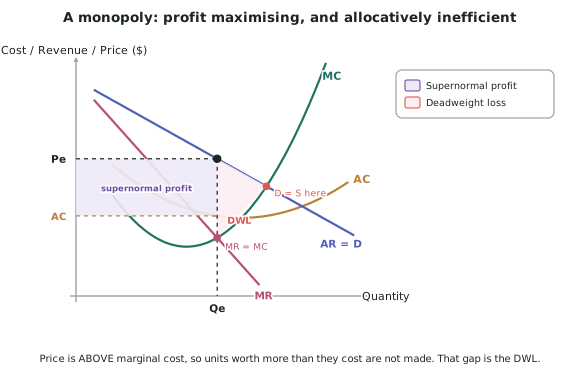
Step 1 — MR = MC fixes the quantity.
- Find where the MR curve crosses MC. Mark it with a dot.
- Drop a vertical line to the quantity axis. That is Qe.
Step 2 — AR fixes the price.
- From Qe, go straight up to the AR curve.
- Read across to the price axis. That is Pe.
Step 3 — AC gives the profit.
- Read the height of AC at Qe.
- Supernormal profit is the rectangle between Pe and AC, out to Qe. Shade it and label it.
Short run and long run for a monopoly
- They are the same. This is the answer to one of the most frequently asked questions in this paper, and the 2025 report lists "recognised that a monopoly's short run price, output, and profit are the same as in the long run" as an Achieved bullet.
- The reason is the barriers to entry. Supernormal profit normally attracts entry, which competes it away — but no firm can enter, so nothing changes.
- The only long-run possibility that differs is if the monopoly makes a loss: with all costs variable in the long run, it would exit the market entirely.
Why a monopoly can make a loss
- Being a monopoly does not guarantee profit. If demand for the product is too small relative to costs, AR may lie below AC at every output.
- The firm still produces where MR = MC in the short run (loss minimising), but in the long run it closes.
Worked ExampleFinding a monopoly's price, output and profit
An illustrative monopoly supplies a patented product. At each output:
| Output (units) | Price / AR ($) | Total revenue ($) | MR ($) | MC ($) | AC ($) |
|---|---|---|---|---|---|
| 1 | 100 | 100 | — | 30 | 90 |
| 2 | 90 | 180 | 80 | 35 | 62 |
| 3 | 80 | 240 | 60 | 45 | 57 |
| 4 | 70 | 280 | 40 | 55 | 56 |
| 5 | 60 | 300 | 20 | 70 | 59 |
Find the profit maximising output and price, and calculate the supernormal profit.
Step 1 — Compare MR and MC at each output
| Output | MR | MC | Comparison | Decision |
|---|---|---|---|---|
| 2 | 80 | 35 | MR > MC | Expand — missing marginal profits |
| 3 | 60 | 45 | MR > MC | Expand — missing marginal profits |
| 4 | 40 | 55 | MR < MC | Do not produce this unit — marginal loss |
At 3 units, MR ($60) is still above MC ($45), so the third unit adds $15 to profit.
At 4 units, MR ($40) is below MC ($55), so the fourth unit would cost $15 more than it earns.
Step 2 — State the profit maximising output
Qe = 3 units. This is where MR = MC most closely — the last output at which MR still exceeds MC.
Written as the four-part chain: at 2 units MR > MC, so the firm is missing out on marginal profits and will increase output to 3 units, the profit maximising point closest to MR = MC.
Step 3 — Find the price from AR, not MR
The price is not $60, the marginal revenue. Read the AR column at 3 units.
Pe = $80.
Note that $80 is well above the MC of $45 — a monopoly always prices above marginal cost.
Step 4 — Calculate supernormal profit
At 3 units, AC is $57.
Profit per unit = Pe − AC = 57 = $23 Supernormal profit = $23 × 3 = $69
Alternatively: total revenue $240 − total cost ($57 × 3 = $171) = $69. The two methods agree.
Step 5 — The long run
Because the product is patented, there are complete legal barriers to entry. No competitor can enter to compete the $69 of supernormal profit away.
The long-run price, output and profit are therefore identical to the short run: $80, 3 units and $69.