The marginal analysis rule
The rule
- A firm maximises profit at the output where marginal revenue equals marginal cost: MR = MC.
- The reason is simple and you must be able to give it in both directions.
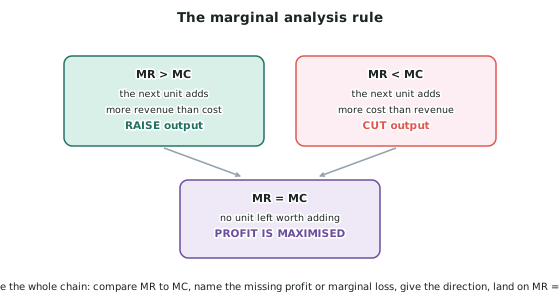
If MR > MC
- The next unit brings in more revenue than it costs to make.
- Producing it therefore adds to profit. Not producing it means the firm is missing out on marginal profits.
- So the firm should increase output.
If MR < MC
- The next unit costs more than it brings in.
- Producing it therefore subtracts from profit — the firm is making a marginal loss on it.
- So the firm should decrease output.
At MR = MC
- There is no unit left that would add to profit, and no unit being made that subtracts from it.
- Profit is maximised.
The four-part sentence the markers want
Both the 2024 and 2025 Assessment Reports quote the same answer as the Excellence standard. It has four parts and they must all be there:
- Compare MR to MC at the starting output — "at the original output of Qe, MR1 > MC"
- Name what that means — "which means the firm is missing out on marginal profits"
- Give the direction of the change — "so to profit maximise it will increase output to Q1"
- Land on the new equilibrium — "at the new profit maximising point of MC = MR1"
- The 2025 Not Achieved list opens with "made no reference to marginal analysis in their responses". Writing this chain, every time, is the difference between failing and passing this standard.
Applying it in each structure
Perfect competition
- MR is the horizontal price line, so MR = P.
- Profit maximising therefore means P (= MR) = MC.
- Find the output by reading down from where the price line crosses MC.
- The standard says this outright, and it is why the perfect competitor is allocatively efficient.
Monopoly
- MR is a separate, lower line.
- Find the output by reading down from where MR crosses MC.
- Then find the price by reading up from that quantity to the AR curve.
- Because AR is above MR, the price ends up above MC, so the monopoly is allocatively inefficient.
The two-step order for a monopoly
Get this order right and the diagram is easy; get it wrong and every label is wrong:
- MR = MC fixes the QUANTITY. Drop a vertical line from that intersection to the quantity axis. That is Qe.
- AR fixes the PRICE. Go back up that vertical line to the AR curve, then across to the price axis. That is Pe.
- The monopoly's price is never read off the MR curve and never off the MC curve.
Worked ExampleApplying marginal analysis to a monopoly
An illustrative monopoly is currently producing at output Qe. At Qe:
- Marginal revenue is $45
- Marginal cost is $28
Demand then increases, shifting the AR curve to AR1 and the MR curve to MR1.
Explain, using marginal analysis, what the monopoly will do to its output, and how it will set its new price.
Step 1 — Compare MR to MC at the starting output
At the original output Qe, marginal revenue is $45 and marginal cost is $28.
MR1 > MC — $45 is greater than $28.
Step 2 — Say what that means
Each additional unit the firm produces brings in $45 of revenue but costs only $28 to make. Every one of those units would add $17 to profit.
By stopping at Qe, the firm is missing out on marginal profits.
Step 3 — Give the direction of the output change
Because MR1 is above MC, the firm can add to profit by producing more. So to profit maximise it will increase output.
It keeps expanding for as long as MR1 stays above MC. As output rises, MR1 falls (because the AR curve slopes down) and MC rises (because of diminishing returns), so the gap closes.
Step 4 — Land on the new profit maximising point
The firm stops expanding at the output Q1 where MR1 = MC. At that point there is no unit left that would add to profit, and no unit being produced that subtracts from it.
Profit is maximised at Q1, where MR1 = MC.
Step 5 — Find the new price
The quantity comes from MR1 = MC. The price does not.
From Q1, go straight up to the AR1 curve, then across to the price axis. That gives the new price P1.
Because AR1 lies above MR1, the price P1 is above the marginal revenue of the last unit, and above marginal cost.
The full sentence
"At the original output of Qe, MR1 > MC, which means the firm is missing out on marginal profits, so to profit maximise it will increase output to Q1, at the new profit maximising point of MC = MR1. The new price P1 is read up from Q1 to AR1."