Natural monopoly
What makes a monopoly "natural"
- A natural monopoly exists where one firm can supply the whole market at a lower average cost than two or more firms could.
- The cause is enormous fixed costs relative to the size of the market, combined with low marginal costs.
- Building a national electricity grid, a water network or a gas pipeline costs billions.
- Sending one more unit of electricity down an existing wire costs almost nothing.
Why the AC curve falls continuously
- AC = TC ÷ Q, and TC is dominated by the huge fixed cost.
- As output rises, that fixed cost is spread over more and more units, so AC keeps falling across the whole relevant range of output.
- It never turns upward within the market, because the market is not big enough to reach the point where diminishing returns would push it up.
- This is called economies of scale, and it is the defining feature.
Why MC lies below AC everywhere
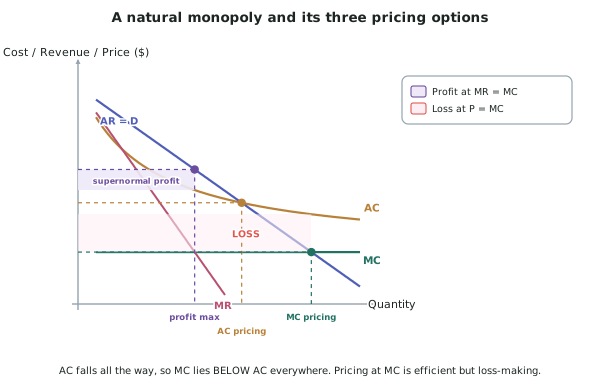
- Whenever AC is falling, MC must be below AC — that is the same arithmetic rule as before, applied to a curve that never stops falling.
- So a natural monopoly's diagram has MC below AC at every output, and MC is often drawn as roughly flat, because the marginal cost of serving one more customer on an existing network is small and fairly constant.
Why the government does not encourage competition here
- This is asked directly and repeatedly. The answer is economies of scale, and it has two parts:
- Duplicating the infrastructure would be wasteful. Building a second set of power lines down every street, or a second water pipe network, would double the enormous fixed cost while serving the same total number of customers.
- Splitting the market raises average cost for everyone. Each firm would serve a smaller output, so each would be further up its falling AC curve. Two firms each serving half the market would both have higher AC than one firm serving all of it.
- So competition in a natural monopoly market makes the industry less efficient, not more. The government therefore permits the monopoly and regulates it instead.
New Zealand's real answer
- The Commerce Commission regulates natural monopolies under Part 4 of the Commerce Act 1986.
- It covers electricity lines businesses, gas pipelines and specified airport services.
- It sets price-quality paths and input methodologies — effectively a cap on what these businesses may charge and a required standard of service.
- This is the New Zealand example to cite whenever a question asks for a government policy to improve the efficiency of a monopoly market.
The unregulated outcome
- Left alone, a natural monopoly profit maximises like any monopoly: MR = MC for the quantity, price read up to AR.
- Because AC is high relative to MC at low outputs, and because it faces the whole market demand curve, the unregulated natural monopoly restricts output sharply and prices well above marginal cost.
- The deadweight loss is correspondingly large, and it falls on services — electricity, water, transport — that are close to essential.
Worked ExampleWhy one firm is cheaper than two
An illustrative electricity lines business has fixed costs of $600 million per year for its network, and a marginal cost of $10 per connection.
The market has 1,000,000 connections in total.
Calculate the average cost per connection if (a) one firm serves the whole market and (b) two firms each build their own network and serve half the market each. Explain what this shows.
Step 1 — One firm serving the whole market
Total cost = fixed cost + (marginal cost × quantity) Total cost = 10 × 1,000,000) Total cost = 10,000,000 = $610,000,000
AC = TC ÷ Q = $610,000,000 ÷ 1,000,000
AC = $610 per connection
Step 2 — Two firms, each with its own network
Each firm must build its own network, so each pays the full $600 million fixed cost. The fixed cost is a property of the network, not of the number of customers on it.
Each firm serves 500,000 connections.
Total cost per firm = 10 × 500,000) Total cost per firm = 5,000,000 = $605,000,000
AC per firm = $605,000,000 ÷ 500,000
AC = $1,210 per connection
Step 3 — Compare
| One firm | Two firms | |
|---|---|---|
| Fixed cost paid in total | $600m | $1,200m |
| Output per firm | 1,000,000 | 500,000 |
| Average cost per connection | $610 | $1,210 |
Average cost per connection is almost exactly double with two firms.
Step 4 — Explain what this shows
Two things are happening at once, and both come from the enormous fixed cost:
- The fixed cost is duplicated. Society spends $1.2 billion building two networks where one would have done. That second network is pure waste — the same customers are served either way.
- Each firm is further up its falling AC curve. With only 500,000 connections each, neither firm can spread its $600 million over as many units, so both have a higher average cost than the single firm did.
This is economies of scale: one firm can supply the whole market at a lower average cost than two or more firms could. That is the definition of a natural monopoly.
Step 5 — The policy conclusion
Encouraging competition in this market would make the industry less efficient, not more, and would push prices up rather than down.
So the government permits the monopoly and regulates it instead. In New Zealand the Commerce Commission does this under Part 4 of the Commerce Act 1986, setting price-quality paths for electricity lines businesses.