Numerical integration — the trapezium rule
When you need it
- Some functions cannot be integrated with the methods in this standard — and among them.
- Sometimes you have data points rather than a formula at all.
- In both cases the area can still be estimated numerically, and the standard names "the rectangle or trapezium rule".
The idea
- Divide the interval into equal strips.
- Approximate each strip by a shape whose area is easy — a rectangle or a trapezium.
- Add the areas.
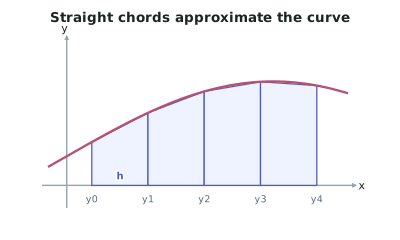
The trapezium rule
- Each part:
- — the number of strips
- — the width of each strip
- — the ordinates, the function values at the strip boundaries
- There are ordinates for strips. Counting them wrong is the most common error.
- The first and last ordinates are counted once; every interior one is doubled.
The method
-
Work out using .
-
List the -values: , , , ..., up to .
-
Calculate each -value by substituting into the function. Keep full accuracy.
-
Substitute into the formula, keeping the first/last and the doubled interior values separate.
-
Evaluate and round at the end.
-
The report lists "did not recognise the value of in the Trapezium rule" among Not Achieved behaviours, so getting right is worth the care.
A tabulated layout
- Setting the work out in a table makes it checkable and shows the marker your method:
| Weight | ||
|---|---|---|
| 1 | ||
| 2 | ||
| 2 | ||
| ... | ... | 2 |
| 1 |
Whether the estimate is too big or too small
- The trapezium rule replaces the curve with straight chords, so:
- Concave up () — the chords lie above the curve, so the estimate is an overestimate
- Concave down () — the chords lie below, so it is an underestimate
- Note that this is a genuinely answerable exam question, and the answer comes from the second derivative or from a sketch — not from guessing.
Improving the estimate
- More strips means a better estimate, because each chord hugs the curve more closely.
- Doubling roughly quarters the error for the trapezium rule.
The rectangle rule
- A cruder alternative, using rectangles instead of trapeziums:
- Left-endpoint rule: rectangle heights taken from the left of each strip
- Right-endpoint rule: heights taken from the right
- Midpoint rule: heights taken from the middle, which is usually the most accurate of the three
- for the left-endpoint rule.
- The trapezium estimate is exactly the average of the left and right rectangle estimates.
Worked ExampleEstimating an integral that cannot be found exactly
Use the trapezium rule with four strips to estimate , giving your answer to 4 decimal places. State, with a reason, whether your estimate is an overestimate or an underestimate.
Step 1 — Note why a numerical method is needed
has no elementary anti-derivative — the reverse chain rule fails because the multiplier is not present and cannot be supplied. A numerical estimate is the only route.
Step 2 — Find the strip width
Step 3 — List the -values
Four strips means five ordinates:
Step 4 — Calculate each ordinate
Substituting into , keeping full accuracy:
| Weight | |||
|---|---|---|---|
| 1 | |||
| 2 | |||
| 2 | |||
| 2 | |||
| 1 |
Step 5 — Apply the formula
The ends, counted once:
The interior values, summed then doubled:
Step 6 — Combine
Step 7 — Decide over- or underestimate
Find the second derivative to determine concavity. With :
Since always, the sign is that of , which is zero at :
- Concave down () for — the chords lie below the curve there
- Concave up () for — the chords lie above the curve there
The concavity is not constant across the interval, so the two effects work in opposite directions.
Comparing with the true value, , the estimate 0.8806 is a slight underestimate — the concave-down region near the origin, where the function values are largest, dominates.