Growth, decay, inflation and Newton's law of cooling
The contexts named in the standard
- The standard lists the applications explicitly: growth and decay, inflation, Newton's Law of Cooling and similar situations.
- All of them are the same differential equation dressed in different words, so recognising the structure is worth more than memorising four separate models.
Exponential growth and decay
- The words to look for: "the rate of change is proportional to the amount present".
- Each part:
- — the initial amount, the value at
- — the rate constant; positive for growth, negative for decay
- Note that a decay problem can be written either as with positive, or as with negative. Read the question to see which convention it uses.
Half-life and doubling time
- Half-life — the time for a quantity to fall to half its value:
- Doubling time — the time to double:
- Both are independent of the starting amount, because cancels. That is the defining feature of exponential change.
Inflation
- Inflation is compound growth applied to prices, and it uses the same model:
- is the inflation rate as a decimal — 3% per year is .
- A New Zealand context: if the Reserve Bank of New Zealand holds inflation at 2% per year, an item costing $40 today is modelled as costing dollars in years — about $48.86 after 10 years.
- Note the distinction between this continuous model and the discrete compound-interest formula . They give slightly different answers; use whichever the question sets up.
Newton's law of cooling
- The statement: the rate at which an object cools is proportional to the difference between its temperature and the surrounding temperature.
-
Each part:
- — the object's temperature at time
- — the surrounding (ambient) temperature, a constant
- — a positive cooling constant
-
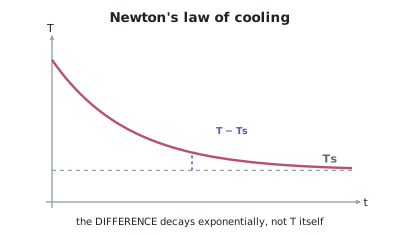
The key structural point: it is the difference that decays exponentially, not itself.
-
Solving it by separation:
- is the initial temperature difference, .
- As , , so — the object approaches room temperature but never quite reaches it. That limiting value is the horizontal asymptote of the cooling curve.
The general method for an applied question
- Identify the model from the wording — proportional to the amount, or to a difference.
- Write the differential equation in symbols.
- Separate and integrate to get the general solution.
- Use the first condition (usually at ) to find the constant .
- Use the second condition to find , which needs logarithms.
- Answer the question, with units and in context.
Interpreting
- A larger means faster change. A hot drink in a cold room has a larger than one in a warm room.
- has units of per unit time — per second, per year — and this is worth stating.
- The sign carries meaning. A positive in a growth model and a negative one in a decay model are not interchangeable, and a sign error inverts the entire prediction.
Worked ExampleNewton's law of cooling
A cup of coffee at 90 °C is left in a room at 20 °C. After 5 minutes its temperature is 70 °C. Assuming Newton's law of cooling, find the temperature after 15 minutes, and find how long it takes to cool to 30 °C.
Step 1 — Write the model
Newton's law says the rate of cooling is proportional to the temperature difference, with :
Step 2 — Separate the variables
Treat as a single unit, since 20 is a constant:
Step 3 — Integrate both sides
Step 4 — Exponentiate
Converting the sum in the exponent into a product:
Step 5 — Apply the first condition to find
At , , and :
Note that is the initial temperature difference, exactly as the theory predicts.
Step 6 — Apply the second condition to find
At , :
Take natural logarithms:
Step 7 — Find the temperature after 15 minutes
Step 8 — Find when the coffee reaches 30 °C
Take logarithms:
Step 9 — Sense-check both answers
- After 5 minutes: 70 °C. After 15: 45.5 °C. After 28.9: 30 °C. The cooling slows down as the coffee approaches room temperature, which is exactly what the model predicts ✓
- The temperature never goes below 20 °C, since for all ✓
- As , °C — the room temperature, which is the horizontal asymptote ✓