Area under a curve
Signed area versus actual area
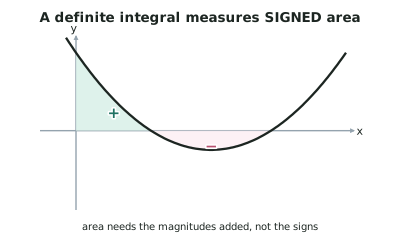
- The definite integral gives signed area:
- Above the -axis — positive
- Below the -axis — negative
- "Area" always means a positive quantity. If part of the curve dips below the axis, the integral under-reports the area, or even cancels it to zero.
The method that always works
-
Sketch the curve over the interval — this is the step that prevents every error on this page.
-
Find the -intercepts inside the interval by solving . These are where the sign changes.
-
Split the integral at each intercept.
-
Evaluate each piece separately.
-
Take the absolute value of any negative piece.
-
Add the magnitudes.
-
Worked through — the area between and the -axis from to :
- Intercepts: , so is inside the interval
- From 0 to 2 the curve is below the axis; from 2 to 3 it is above
- Area square units
- The integral over the whole interval would have been — a completely different number.
When splitting is not needed
- If the curve stays entirely above the axis on the interval, the integral is the area and no splitting is required.
- If it stays entirely below, the area is the magnitude of the integral.
- Check by sketching, not by assuming.
Area between a curve and the -axis
- Some questions ask for the area between a curve and the vertical axis. Then you integrate with respect to :
- Rearrange the equation to make the subject, and use -limits.
- For with , the area between the curve and the -axis from to is .
Units
- Area from an integral is in square units of whatever the axes measure.
- If is in seconds and is in metres per second, the "area" is a distance in metres — the units multiply.
- Always interpret the units in context when the question is applied rather than purely geometric.
Curves with an unknown boundary
- A common Merit/Excellence turn: "the region enclosed between the curve and the axis has area 36; find ".
- Set up the integral with as a limit.
- Evaluate in terms of .
- Set equal to the given area and solve.
- Check the solution makes sense — a boundary outside the region is invalid.
Worked ExampleAn area with a sign change
Find the total area enclosed between the curve and the -axis for .
Step 1 — Find the -intercepts
Set and factorise fully:
All three lie in the interval, and is an interior crossing — so the region is in two parts.
Step 2 — Determine the sign on each part
Test a point in each sub-interval:
- At : — the curve is above the axis on
- At : — the curve is below the axis on
Step 3 — Find the anti-derivative once
Step 4 — Evaluate the first piece
Upper limit:
Lower limit:
Positive, as the sign test predicted ✓
Step 5 — Evaluate the second piece
Upper limit:
Lower limit:
Negative, as predicted ✓
Step 6 — Take magnitudes and add
Step 7 — See what the unsplit integral would have given
Zero — the two regions cancel exactly, because has rotational symmetry about the origin.
An answer of 0 for an area that is visibly not empty is the clearest possible demonstration of why the split is necessary.