Integrating powers and polynomials
Reversing the power rule
- Differentiating multiplies by the power and reduces it by one. Integrating does the opposite: raise the power by one and divide by the new power.
-
Each part:
- — the integral sign, meaning "anti-differentiate"
- — states that is the variable being integrated with respect to
- — the constant of integration
- — because dividing by is impossible; that case gives a logarithm instead
-
, and .
Why there is a constant
- Differentiating destroys constants: , and all have derivative .
- So anti-differentiating cannot recover which constant was there. Every possible constant is a valid answer, and says so.
- describes an entire family of curves, all identical in shape and stacked vertically.
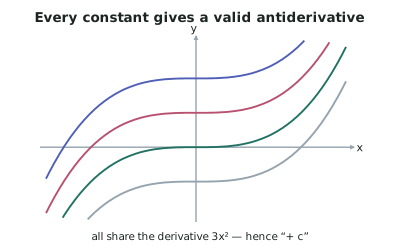
- The report's warning: the constant "should not be omitted and, additionally, its value need not necessarily be zero". Assuming without evidence is as wrong as leaving it out.
Constants and sums
- A constant multiplier comes outside:
- Integrate term by term:
-
Only one is needed for the whole expression, not one per term.
-
Integrating a constant gives that constant times :
(which makes sense: , so raising the power gives ).
Negative and fractional powers
-
The rule works for these too — convert first, then apply it.
-
Worked through:
- Note the fraction arithmetic: dividing by is multiplying by . The report lists "did not recognise that is " and "did not recognise that is " among Not Achieved behaviours.
Preparing an expression first
-
The rule works on terms, so expand and split before integrating.
-
Expand brackets:
- Split a single-term denominator:
(note the second term is the case and needs the logarithm rule, covered later).
- You cannot integrate a product by integrating each factor. is not . There is no product rule for integration in this standard — expand or use the reverse chain rule instead.
Finding the constant from a given point
-
If you are told the curve passes through a particular point, the constant can be found:
- Integrate to get the general expression with .
- Substitute the given and values.
- Solve for .
- Rewrite the full particular solution.
-
Worked through — find given and the curve passes through :
- , so
Checking your answer
- Differentiate what you got. If it does not return the original expression, the integration is wrong.
- This takes ten seconds and catches almost every technique error.
Worked ExampleFinding a curve from its gradient function
A curve has gradient function and passes through the point . Find the equation of the curve.
Step 1 — Simplify before integrating
The expression is a quotient, but the denominator is a single term, so it can be split.
First convert the surd:
Then divide each term by , subtracting exponents:
Step 2 — Integrate the first term
Raise the power by one and divide by the new power:
Step 3 — Integrate the second term
The power is , so the new power is :
Note that dividing by multiplies by 2 — a common place to lose a factor.
Step 4 — Write the general solution
Add the constant of integration once, for the whole expression:
Step 5 — Use the given point to find
Substitute and :
Step 6 — Write the particular solution
Step 7 — Check by differentiating
which is the simplified gradient function from Step 1 ✓
And substituting : ✓ the curve passes through .