Area between two curves
The formula
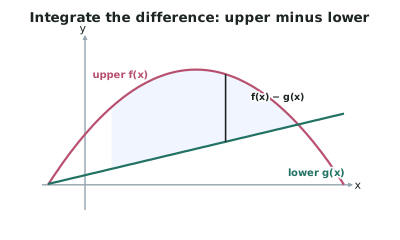
- The area of the region enclosed between two curves is:
-
Each part:
- — the upper curve on the interval
- — the lower curve
- , — the -values of the points of intersection, usually
-
The subtraction must be top minus bottom. Getting it the other way round gives the right magnitude with the wrong sign.
Why the sign issue disappears
- Because you integrate the difference, the region between the curves is measured directly — and it does not matter whether either curve is above or below the -axis.
- If both are below the axis, the difference is still positive as long as is the upper one.
- This is a genuine simplification, and it is why "area between curves" is often easier than "area under a curve".
The method
-
Find the points of intersection by setting and solving. These give the limits.
-
Sketch, or test a point between the intersections to see which curve is on top.
-
Set up .
-
Integrate and evaluate.
-
Worked through — the area between and :
- Intersections: , so , giving and
- Test : the line gives 2, the parabola gives 1 — the line is on top
When the curves cross inside the interval
- If the two curves swap over partway through, the region must be split at each crossing point.
- On each piece, subtract in the order appropriate to that piece.
- Then add the results — both will be positive if done correctly.
Limits that are not intersections
- Sometimes the region is bounded by given vertical lines rather than by the curves meeting.
- Use the given -values as limits, but still check which curve is on top on that interval, and still check whether they cross inside it.
Horizontal strips
- If the region is more naturally described by -limits — for example bounded left and right by curves — integrate with respect to :
- Rearrange both equations to make the subject first.
- Choose whichever direction needs fewer splits.
Checking your answer
- An area between curves must be positive. A negative result means the subtraction was the wrong way round — fix the order rather than just dropping the sign.
- Estimate from the sketch. If the region looks like roughly a rectangle and your answer is 30, something is wrong.
Worked ExampleA region where the curves cross
Find the total area of the regions enclosed between and .
Step 1 — Find the points of intersection
Set the two expressions equal:
Factorise fully — do not divide by , which would lose a solution:
Three intersection points, so the curves cross in the middle and the region comes in two separate pieces.
Step 2 — Determine which curve is on top in each piece
Test (in the interval ):
The cubic is higher (), so on this piece: upper , lower .
Test (in the interval ):
The line is higher, so on this piece: upper , lower .
Step 3 — Set up the first integral, to
Integrate:
Upper limit:
Lower limit:
Positive ✓ — confirming the order was right.
Step 4 — Set up the second integral, to
Note the reversed order of subtraction:
Upper limit:
Lower limit:
Positive ✓
Step 5 — Add the two pieces
Step 6 — Check
Both pieces came out positive, which confirms each subtraction was in the right order.
The two areas being equal is expected: and are both odd functions, so the whole configuration has rotational symmetry about the origin and the two lobes must be congruent ✓
What would have gone wrong without the split:
— the two pieces cancel exactly, giving zero for a region that plainly has area.