Tangents and normals
The gradient at a point
- is a function — it gives the gradient at every point on the curve.
- is a number — the gradient at the single point where .
- Substitute after differentiating, never before. Substituting first turns the function into a constant, whose derivative is zero.
Finding the equation of a tangent
- A tangent is the straight line that touches the curve at a point and has the same gradient as the curve there.
- The procedure:
- Differentiate to get .
- Substitute the -value to get the gradient .
- Find the -coordinate by substituting into the original function, .
- Apply the straight-line formula:
-
Rearrange into the form the question asks for.
-
Worked through — the tangent to at :
- , so
- , so the point is
- , giving
Finding the equation of a normal
- A normal is the line perpendicular to the tangent at the same point.
- Perpendicular gradients multiply to , so:
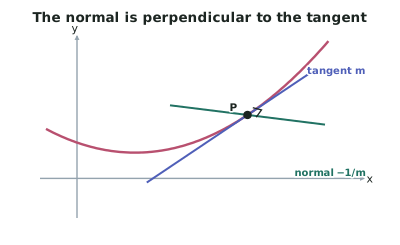
-
The procedure is identical to the tangent, with one extra step: flip the gradient and change its sign.
-
Continuing the example above: , so the normal is , or .
-
Special cases:
- A horizontal tangent () has a vertical normal, written — the formula does not apply.
- A vertical tangent has a horizontal normal, .
When you are given the gradient instead of the point
-
A common exam turn: "find the point(s) where the tangent has gradient 5".
-
Set and solve for . There may be more than one answer.
-
Substitute each solution back into the original function for the -coordinates.
-
Note the error the reports flag repeatedly: candidates "misunderstood the relationship between the gradient and the derivative, instead substituting the gradient value into the original function". The gradient goes into , not into .
Where a tangent meets the axes or another line
- These are ordinary co-ordinate geometry questions once the tangent's equation is found:
- -intercept: set and solve.
- -intercept: set .
- Intersection of two tangents: solve the two line equations simultaneously.
- The 2025 report lists "found the coordinates of the point of intersection of two tangents to a curve" and "found the coordinates of the point where a tangent to a curve crosses the -axis" as Merit behaviours.
Tangents from an external point
- If a tangent passes through a point that is not on the curve, the touch point is unknown. Call it :
- The gradient at the touch point is .
- The gradient of the line joining to is .
- Set these equal and solve for .
- There are often two such tangents, so expect two solutions.
Worked ExampleTangent, normal, and the triangle they form
Find the equations of the tangent and the normal to at the point where , and find the area of the triangle formed by the normal and the two axes.
Step 1 — Find the point on the curve
Substitute into the original function:
The point is .
Step 2 — Differentiate
Convert to index form first, then apply the power rule:
Step 3 — Find the gradient of the tangent
Now substitute into the derivative:
Step 4 — Write the tangent's equation
Using with the point :
Step 5 — Find the gradient of the normal
Flip and change sign:
Step 6 — Write the normal's equation
Through the same point :
Step 7 — Find where the normal meets the axes
The normal is .
- -intercept: set , giving
- -intercept: set , giving
Both intercepts are at the origin, so the normal passes through the origin and does not cut off a triangle at all.
Step 8 — Re-read and use the tangent instead
The normal forms no triangle, so the intended triangle must come from the tangent :
- -intercept: , so — the point
- -intercept: — the point
Step 9 — Find the area
The triangle has its right angle at the origin, with legs along the axes:
The lesson: always check whether a line actually cuts off a region before computing an area. A line through the origin never does.