Limits and discontinuities
What a limit is
- A limit describes what a function approaches as gets close to a value — not necessarily what it equals there.
- Read this as: "as approaches , approaches ".
- The function need not be defined at at all. The limit is about the journey, not the destination.
Finding a limit by substitution
- For most functions, substitute the value in:
- If substitution gives a number, that is the limit and you are finished.
When substitution gives
- is called an indeterminate form. It does not mean the limit fails to exist — it means substitution was the wrong tool.
- Factorise and cancel, then substitute again:
- Note that is genuinely undefined at — you cannot divide by zero. But the limit is still 4, because the function approaches 4 from both sides.
One-sided limits
- is the left-hand limit — the value approached coming from below.
- is the right-hand limit — approached from above.
- The two-sided limit exists only if both one-sided limits exist and are equal:
- This is the test you apply to piecewise functions, which is how NZQA usually assesses limits.
The three kinds of discontinuity
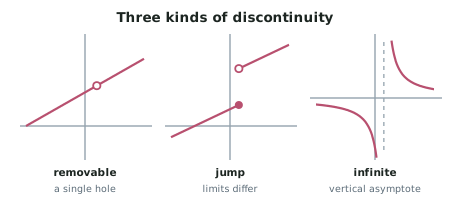
- Removable discontinuity — a single hole. The limit exists, but the function is either undefined there or defined at the wrong value. Drawn as an open circle.
- Jump discontinuity — the left and right limits both exist but are different, so the two-sided limit does not exist. Typical of piecewise functions with mismatched pieces.
- Infinite discontinuity — the function grows without bound, giving a vertical asymptote. The limit does not exist.
Limits at infinity
-
describes the long-run behaviour — the horizontal asymptote, if there is one.
-
For a rational function, compare the degrees of numerator and denominator:
- Degree of top < degree of bottom — the limit is 0
- Degrees equal — the limit is the ratio of the leading coefficients
- Degree of top > degree of bottom — no finite limit; the function grows without bound
-
Worked through:
- (equal degrees, leading coefficients 3 and 5)
- (bottom wins)
-
Useful limits worth knowing:
Vertical asymptotes
- A vertical asymptote occurs where the denominator is zero and the numerator is not.
- For , the denominator vanishes at while the numerator gives 4, so there is a vertical asymptote at .
- If both vanish, factorise first — you may have a hole rather than an asymptote.
Worked ExampleMaking a piecewise function continuous
The function is defined by Find the value of that makes continuous at , and state the limit there.
Step 1 — State what continuity requires
For to be continuous at , three things must all hold and agree:
- the left-hand limit must exist
- the right-hand limit must exist
- both must equal the function value
Step 2 — Find the left-hand limit
Approaching from below means , so the first piece applies:
Step 3 — Find the right-hand limit
Approaching from above means , so the second piece applies:
Step 4 — Set the two limits equal
The two-sided limit exists only when the one-sided limits agree:
Step 5 — Check the function value matches
Continuity also needs itself to equal the limit. Since falls in the second piece:
All three quantities are 5, so is continuous at .
Step 6 — Sense-check with a sketch
With , the parabola rises to the point , and the line starts from exactly that point. The two pieces join without a jump.