Stationary points and their nature
What a stationary point is
- A stationary point is a point where the curve has a horizontal tangent:
- The three kinds:
- Local maximum — the curve rises to the point and falls away
- Local minimum — the curve falls to the point and rises away
- Stationary point of inflection — the curve flattens but carries on in the same direction
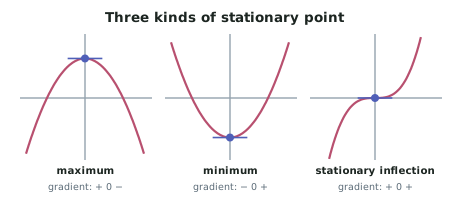
- "Local" means within a neighbourhood. A local maximum need not be the highest point on the whole curve.
Finding stationary points
-
Differentiate to get .
-
Set and solve — write this equation down explicitly.
-
Substitute each solution into the original function to get the -coordinates.
-
State the coordinates as points, not just -values.
-
Worked through for :
- gives and
- and
- Stationary points: and
Method 1 — the second derivative test
-
Differentiate again and substitute the -value:
- — the curve is concave down, so a maximum
- — the curve is concave up, so a minimum
- — the test fails; use the sign test instead
-
A memory aid: a negative second derivative means a hill; a positive one means a valley.
-
Continuing the example: .
- , so is a minimum
- , so is a maximum
-
Note the trap: does not prove an inflection. For , but the origin is a minimum.
Method 2 — the sign test on
- Always works, including when the second derivative test fails.
- Choose a value of just below and just above the stationary point.
- Evaluate the sign of at each — the sign is all you need, not the value.
- Read the pattern:
| Sign of before | at the point | after | Nature |
|---|---|---|---|
| Maximum | |||
| Minimum | |||
| Inflection | |||
| Inflection |
- Choose test values carefully — they must lie between neighbouring stationary points, not beyond them.
Method 3 — an annotated sketch
- The 2026 specification for Level 2 explicitly permits justifying the nature "with an annotated sketch of the shape of the curve", and the same reasoning is accepted at Level 3.
- For a cubic with a positive leading coefficient, the shape is fixed: it rises, turns down at a maximum, turns up at a minimum, then rises. The left-hand turning point is the maximum.
Global maximum and minimum on an interval
- On a closed interval , the largest and smallest values can occur either at a stationary point or at an endpoint.
- Evaluate the function at every stationary point in the interval and at both endpoints, then compare.
- Forgetting the endpoints is a standard error in optimisation questions with a restricted domain.
Reading stationary points from
- If you are given the graph of rather than :
- Stationary points of are where the graph of crosses the -axis.
- A crossing from positive to negative is a maximum of ; negative to positive is a minimum.
- A touch of the axis without crossing is a stationary point of inflection.
Worked ExampleStationary points of a rational function
Find the coordinates and nature of the stationary points of .
Step 1 — Simplify before differentiating
The denominator is a single term, so split the fraction rather than reaching for the quotient rule:
Note the domain: .
Step 2 — Differentiate
Step 3 — State the stationary condition explicitly
Write the equation down before manipulating it — this is what the assessor report asks for:
Step 4 — Solve
Both roots are kept. The square root has two values, and both are in the domain since neither is 0.
Step 5 — Find the -coordinates
Substitute into the original function:
The stationary points are and .
Step 6 — Find the second derivative
Step 7 — Test each point
At :
Positive, so concave up — a minimum at .
At :
Negative, so concave down — a maximum at .
Step 8 — Sense-check
A "maximum" lower than a "minimum" looks wrong, but it is correct here: the curve has a vertical asymptote at separating two entirely separate branches. Each turning point is a local extremum on its own branch, and neither is global.