Continuity, differentiability and concavity
Continuity in one sentence
-
A function is continuous at if you can draw through that point without lifting your pen.
-
Formally, all three of these must hold:
- is defined
- exists
- the two are equal:
-
If any one fails, the function is discontinuous at .
Differentiability
- A function is differentiable at if exists — that is, if the curve has a single well-defined tangent there.
- The graph must be smooth, with no corner, cusp or break.
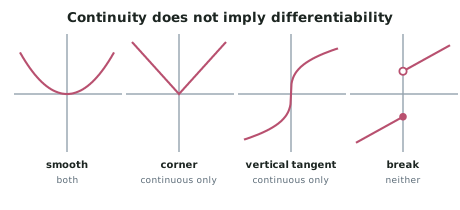
The one-way relationship
-
Differentiable continuous. If a curve has a tangent at a point, it cannot have a break there.
-
Continuous differentiable. A curve can be unbroken and still have a sharp corner.
-
The standard counterexample is at : unbroken, but the gradient is on the left and on the right, so there is no single gradient at the origin.
-
The three ways differentiability fails while continuity holds:
- Corner — the left and right gradients exist but differ
- Cusp — the gradients head to and
- Vertical tangent — the gradient is infinite, so does not exist as a number
Testing a piecewise function for differentiability
-
Check continuity first. If the pieces do not join, differentiability is impossible — stop there.
-
Differentiate each piece separately.
-
Evaluate both derivatives at the joining point.
-
Compare. Equal means differentiable; unequal means a corner.
-
Worked through for for and for :
- Continuity: and ✓ they join
- Gradients: gives 2 at ; the constant gradient of the line is 2
- Equal, so is differentiable at — the line is exactly the tangent to the parabola there.
Concavity
-
Concavity describes which way a curve bends, and it is read from the second derivative .
-
Concave up () — the curve bends upwards, like a valley or a cup that holds water. The gradient is increasing.
-
Concave down () — the curve bends downwards, like a hill. The gradient is decreasing.
-
Note the distinction that catches people out: concavity is about whether the gradient is increasing, not whether the function is increasing. A curve can be falling steeply and still be concave up, if it is falling less and less steeply.
What the two derivatives tell you
| increasing, concave up | decreasing, concave up | |
| increasing, concave down | decreasing, concave down |
- answers "is it going up or down?"
- answers "which way is it bending?"
Increasing and decreasing intervals
-
A function is increasing on an interval where , and decreasing where .
-
To find the intervals:
- Differentiate and set to find the boundaries.
- Test the sign of in each interval between them.
- State the intervals in terms of .
-
The 2025 report lists "provided the conditions, using the derivative, for when a function is decreasing" as an Achieved-level behaviour, so these questions appear regularly.
Reading properties off a graph
- Exam questions frequently supply a piecewise graph and ask you to read features from it. What to look for:
- Break in the curve — discontinuous, and therefore not differentiable
- Sharp corner — continuous but not differentiable
- Horizontal tangent — , a stationary point
- Curve bending upwards —
- Change in bending direction — a point of inflection
Worked ExampleTesting a piecewise function
The function is defined by Determine whether is (a) continuous and (b) differentiable at .
Step 1 — Test continuity: the left-hand limit
For the first piece applies:
Step 2 — Test continuity: the right-hand limit
For the second piece applies:
Step 3 — Compare, and check the function value
Both one-sided limits are 3, so the two-sided limit exists and equals 3.
The function value at comes from the first piece (because it is defined for ):
All three agree, so is continuous at .
Step 4 — Differentiate each piece
Step 5 — Evaluate both at the joining point
Left-hand gradient, from the parabola:
Right-hand gradient, from the line — a line has the same gradient everywhere:
Step 6 — Compare
The one-sided gradients are different, so there is no single tangent at and is not differentiable there.
Step 7 — Interpret
The graph has a corner at : the parabola arrives with gradient 2 and the line leaves with gradient 4, so the curve changes direction abruptly without breaking.