Points of inflection
What an inflection is
- A point of inflection is where a curve changes its concavity — where it stops bending one way and starts bending the other.
- It is a change in how the curve bends, not in whether it is rising or falling.
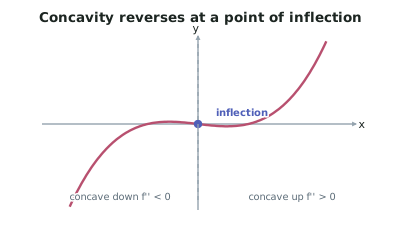
- At an inflection the gradient is at a local extreme — the curve is at its steepest or shallowest there, in the sense that itself turns around.
The two types
- Non-stationary inflection — but . The concavity flips while the curve is still climbing or falling. This is the usual case.
- Stationary inflection — and . The curve flattens completely, then carries on in the same direction. at the origin is the standard example.
Finding points of inflection
-
Differentiate twice to get .
-
Solve — these are the candidates, not the answers.
-
Test for a sign change in either side of each candidate.
-
Substitute into the original function for the -coordinate.
-
The sign-change test is not optional. alone proves nothing.
Why the test matters
-
has , which is zero at .
-
But is a perfect square — it is positive on both sides and merely touches zero. The concavity never changes, so the origin is a minimum, not an inflection.
-
Compare , where crosses zero, going from negative to positive. That is a genuine inflection.
-
The rule: must cross the axis, not touch it.
Setting out the sign test
-
Choose a test value just below and just above the candidate.
-
Evaluate the sign of at each.
-
State the conclusion in words.
-
Worked through for :
- and
- at
- (concave down) and (concave up)
- The concavity changes, so there is an inflection at
- , so the point is
What the two derivatives say together
- tells you whether the curve is going up or down.
- tells you which way it bends.
- An inflection is a change in , which says nothing about whether changes — and usually it does not.
- Note that a curve can be increasing throughout and still have an inflection. rises everywhere and has one at the origin.
Inflections on a cubic
- Every cubic has exactly one point of inflection.
- Since is linear for a cubic, it has exactly one root and always crosses the axis there.
- That inflection is the centre of symmetry of the cubic — the curve has rotational symmetry of order 2 about it.
- For , it sits at , exactly midway between the two turning points when they exist.
Sketching with all the information
- A full sketch uses everything on the last three pages:
- Intercepts — set and
- Stationary points — from , with their nature
- Inflections — from with a sign change
- Asymptotes — from the denominator and from limits at infinity
- End behaviour — what happens as
Worked ExampleA full analysis of a quartic
For , find all stationary points and all points of inflection, stating the nature of each.
Step 1 — Find both derivatives
Step 2 — Find the stationary points
Set the first derivative to zero and factorise:
Coordinates, substituting into the original function:
Stationary points: and .
Step 3 — Classify with the second derivative
Positive, so is a minimum.
Step 4 — Classify
The test fails, so use a sign test on :
- At : — negative
- At : — negative
The gradient is negative on both sides, so the curve does not turn: is a stationary point of inflection.
Step 5 — Find the candidate inflections
Set the second derivative to zero:
Step 6 — Test for a concavity change
- — positive (concave up)
- — negative (concave down)
The sign changes, so is a genuine inflection — and since as well, it is the stationary inflection already identified. The two methods agree ✓
Step 7 — Test for a concavity change
- — negative (concave down)
- — positive (concave up)
The sign changes, so is also an inflection. Its height:
Since , this is a non-stationary inflection — the curve is falling as it passes through.
Step 8 — Summarise
| Point | Nature | ||
|---|---|---|---|
| , changes sign | Stationary point of inflection | ||
| , changes sign | Non-stationary point of inflection | ||
| Local minimum |