Optimisation
What optimisation asks
- An optimisation problem asks for the largest or smallest value something can take — maximum volume, minimum cost, largest area for a fixed perimeter.
- The mathematics is just stationary points. The difficulty is building the equation, and that is exactly where the marks are.
- The 2025 report: "Modelling for optimisation problems continues to be a skill demonstrated by high-performing candidates. Candidates need a lot more practice at understanding how to deal with creating appropriate models."
The method
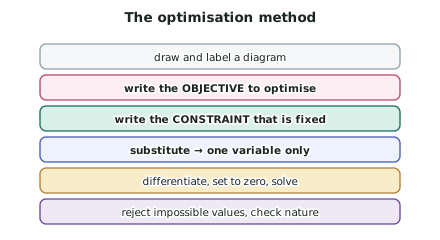
- Draw a diagram and label every unknown with a letter.
- Write the objective — the quantity to be maximised or minimised — as an equation.
- Write the constraint — the fixed condition given in the problem.
- Use the constraint to eliminate a variable, so the objective depends on one variable only.
- Differentiate the objective and set it to zero.
- Solve, and reject any answer that makes no physical sense.
- Answer the question that was asked — often the maximum value, sometimes the dimensions that achieve it.
Why the constraint matters
-
The objective usually starts with two variables — a box's volume depends on both length and height.
-
You cannot differentiate a two-variable expression with the tools in this standard.
-
The constraint is what removes the second variable. Finding it is half the modelling.
-
Worked through — a rectangle with perimeter 40 m, maximise the area:
- Objective:
- Constraint: , so
- Substitute:
- Differentiate:
- Set to zero: , so and m2
- The optimal rectangle is a square — a result worth remembering as a sanity check.
Formulae you are expected to know
- The Level 2 specification says candidates "should be familiar with common 2D and 3D shapes and their associated formulae", and the same expectation carries to Level 3:
- Rectangle: ,
- Circle: ,
- Cylinder: , curved surface , total surface
- Cone: , curved surface
- Sphere: , surface
- Cuboid: , surface
Rejecting invalid solutions
- Physical quantities cannot be negative. A length of m is not an answer.
- State the rejection explicitly: " is rejected because a length must be positive."
- Also check the domain. If a piece of wire 20 cm long is cut, then , and any solution outside that range is invalid.
Justifying the maximum or minimum
- The 2026 specification is explicit: at Achieved and Merit the paper will not require you to prove which you have found. It will say something like "you may assume your solution is a minimum".
- At Excellence, or when the question asks, justify it by:
- the second derivative — negative for a maximum, positive for a minimum, or
- testing gradients either side, or
- an argument from context — "the area must be zero at both ends of the range, so the single stationary point in between is the maximum".
Optimisation on a closed interval
- If the variable is restricted, the extreme value may occur at an endpoint rather than at a stationary point.
- Evaluate the objective at every stationary point in range and at both endpoints, then compare the values.
Worked ExampleMinimising the surface area of a can
A cylindrical can is to hold 500 cm3 of liquid. Find the radius that minimises the total surface area, and the minimum surface area, correct to 3 significant figures.
Step 1 — Draw and label
A closed cylinder with radius and height , both in centimetres. Two unknowns, so we will need a constraint.
Step 2 — Write the objective
The quantity to minimise is the total surface area — two circular ends plus the curved side:
This contains two variables, so it cannot be differentiated yet.
Step 3 — Write the constraint
The volume is fixed at 500 cm3:
Step 4 — Eliminate
Rearrange the constraint to make the subject:
Substitute into the objective:
Simplify — the cancels and one cancels:
Step 5 — Differentiate
Convert to index form first:
Step 6 — Set the derivative to zero
State the condition explicitly before rearranging:
Multiply both sides by :
Step 7 — Solve
Only one real cube root exists, and it is positive, so there is nothing to reject.
Step 8 — Confirm it is a minimum
For any both terms are positive, so throughout the physically meaningful domain. The stationary point is therefore a minimum, and since it is the only one it is the global minimum.
Step 9 — Find the minimum surface area
Substitute the unrounded value into the area expression:
Step 10 — Sense-check
The corresponding height is cm, which is exactly . The optimal can is as tall as it is wide — a standard result, and a good check that the working is right ✓