The chain rule
When you need it
-
The chain rule is for a function inside another function — a composite function.
-
is "raise to the fifth power" applied to "".
-
is "take the sine" applied to "".
-
is "exponentiate" applied to "".
-
Recognising a composite is the skill. Ask: if I had to evaluate this for , what would I compute first? That inner computation is the inside function.
The rule
- Or, in the form most people use:
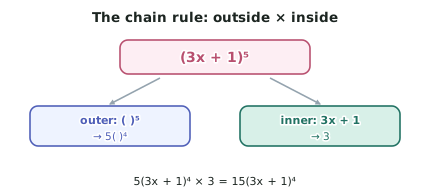
- In words: differentiate the outside, leave the inside alone, then multiply by the derivative of the inside.
- The last factor is what students call "the multiplier", and dropping it is the single most-reported error in this standard.
The substitution method
-
The safest way to set out a chain rule question:
- Let be the inside function.
- Write in terms of .
- Differentiate both: find and .
- Multiply them together.
- Substitute the inside function back in, so the answer is in terms of .
-
Worked through for :
- Let , so
- and
The standard patterns
- Once the method is fluent, these can be written straight down:
Chains inside chains
-
Some functions need the rule applied twice, working from the outside in.
-
Worked through for , which is :
- Outermost: cube, so
- Next layer: derivative of is
- Multiply:
-
Note that each layer contributes a factor. A three-layer function has three factors in its derivative.
Roots as powers
- Always convert before applying the rule:
Fractions that are really chains
- looks like a job for the quotient rule, but writing it as makes it a chain rule problem, which is much shorter:
- Whenever the numerator is a constant, use a negative power and the chain rule. Reaching for the quotient rule there is extra work for extra risk.
Worked ExampleA double chain rule
Find for .
Step 1 — Identify the layers
Reading from the outside in, there are three things happening:
- outermost: a square root
- middle: the cosine
- innermost: the
So the chain rule will be applied twice, and the answer will have three factors.
Step 2 — Convert the root to a power
Never differentiate a root as a root:
Step 3 — Differentiate the outermost layer
Bring down the power, reduce it by one, and leave the inside untouched:
Step 4 — Multiply by the derivative of the inside
The inside is . Differentiating it needs the chain rule again: cosine gives , and the multiplier is the derivative of , which is 4.
Step 5 — Assemble the three factors
Step 6 — Simplify
Combine the numerical factors, , and write the negative power back as a root:
Step 7 — Check the factors are all present
- and the reduced power — from the square root ✓
- — from the cosine ✓
- — from the ✓
All three layers have contributed. Missing any one of them makes the whole answer wrong.