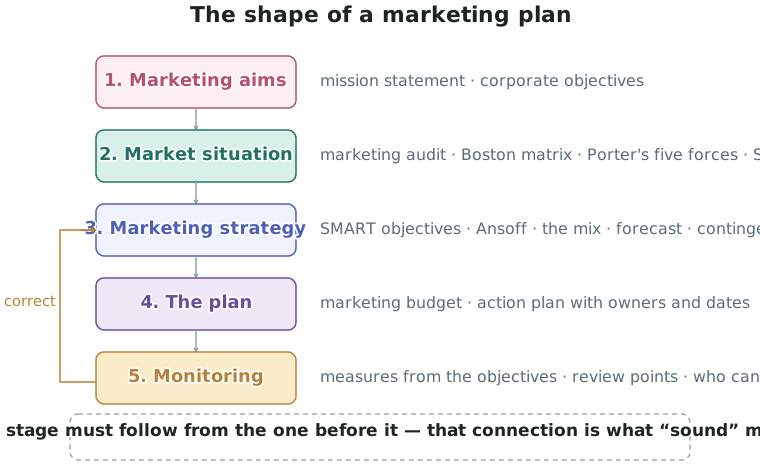
The four stages of a marketing plan
The task
- The work is to develop a marketing plan for a new or existing product — a document a business could act on.
- A new product is one not yet on the market; an existing product is one already being sold. Either is allowed, but the two are not researched the same way — a new product has no marketing history to audit, so the audit is done on the nearest competitor product or on the market it will be launched into.
- The work breaks into four stages, each with its own definition. Learn the definitions — they tell you exactly what must be in the plan.
| Stage | What it means | What you produce |
|---|---|---|
| Marketing aims | Mission statement and corporate objectives | What the business as a whole is trying to achieve |
| The market situation | Marketing audit, SWOT analysis, marketing assumptions | An evidenced picture of where the product stands now |
| Marketing strategy | Marketing objectives, SMART goals, forecasting, contingency plans | What you will achieve, and how |
| The marketing plan | Marketing budget and a detailed action plan for implementation and future monitoring | Who does what, when, for how much, and how you will know it worked |
Three depths of the same plan
- You are producing a document rather than answering questions, so what separates a weak plan from a strong one is how far each stage is taken:
| Depth | What the plan does |
|---|---|
| The floor | Develop the plan: set aims, explain the market situation, create a strategy, write a plan. Complete, and it stops there |
| Sound | Fully explain the market situation, and make the strategy and the plan sound |
| Thorough | Evaluate the market situation, and make the strategy and the plan thorough |
- What the words mean in practice:
- Sound — the parts fit together and are supported by evidence. The strategy follows from the situation; the plan delivers the strategy.
- Thorough — nothing is missing, everything is justified, alternatives were considered and rejected for stated reasons, and the plan anticipates what could go wrong.
- Evaluate the market situation — do not just describe the audit and the SWOT. Say which factors matter most, why, and what they mean for the strategy.
The one rule the whole plan rests on
- Every stage must follow from the one before it. This is what markers mean by a sound plan.
- The aims come from the business's mission and corporate objectives.
- The situation analysis identifies the gap between where the product is and where the aims say it should be.
- The strategy closes that gap, and is chosen because of what the situation analysis found.
- The plan delivers the strategy, and the budget is sized to it.
- The monitoring measures the objectives the strategy set.
- A plan where the SWOT identifies a weak distribution network and the strategy is a social media campaign is not sound, however well each part is written separately.
What a finished plan contains
- A typical structure, in order:
- Executive summary — one page, written last
- The business and its mission — mission statement, corporate objectives
- The product — what it is, who it is for
- Market situation — marketing audit, market research findings, Boston matrix, Porter's five forces, SWOT, assumptions
- Marketing objectives — SMART, and linked to the corporate objectives
- Marketing strategy — target market and segments, positioning, the marketing mix, the Ansoff position
- Sales forecast — with the assumptions it rests on
- Marketing budget — costed by activity
- Action plan — activity, responsibility, date, cost
- Monitoring and review — measures, review points, who reviews
- Contingency plans — what happens if the main assumptions prove wrong