SWOT, Porter's five forces and marketing assumptions
SWOT analysis
- SWOT organises the situation into four boxes:
- Strengths — internal, and helpful. What the business does better than competitors.
- Weaknesses — internal, and harmful. What it does worse, or cannot do at all.
- Opportunities — external, and helpful. Changes outside the business it could take advantage of.
- Threats — external, and harmful. Changes outside the business that could damage it.
- The internal/external split is where most SWOTs go wrong. Strengths and weaknesses are things the business controls; opportunities and threats are not.
- "Strong brand" is a strength. "Growing demand for premium chocolate" is an opportunity, not a strength.
- "We might lose our main distributor" is a threat. "We depend on one distributor" is a weakness.
Making a SWOT worth writing
- A SWOT is only useful if it is specific, evidenced and acted on:
- Specific. Not "good products" but "the only New Zealand-made single-origin bar in the premium grocery channel".
- Evidenced. Each point should trace back to something in the audit or the research.
- Acted on. The strategy must use the strengths, address the weaknesses, pursue the opportunities and plan for the threats. A SWOT that appears in the plan and is never referred to again is decoration.
- The move that lifts it to Excellence is pairing:
- Strength × opportunity — where should we attack? The strength that lets us take the opportunity.
- Weakness × threat — where are we exposed? The weakness that makes the threat dangerous.
- Strength × threat — what defends us?
- Weakness × opportunity — what must we fix before we can take this?
- Pairing turns a list into an argument, and the argument is the strategy.
Porter's five forces
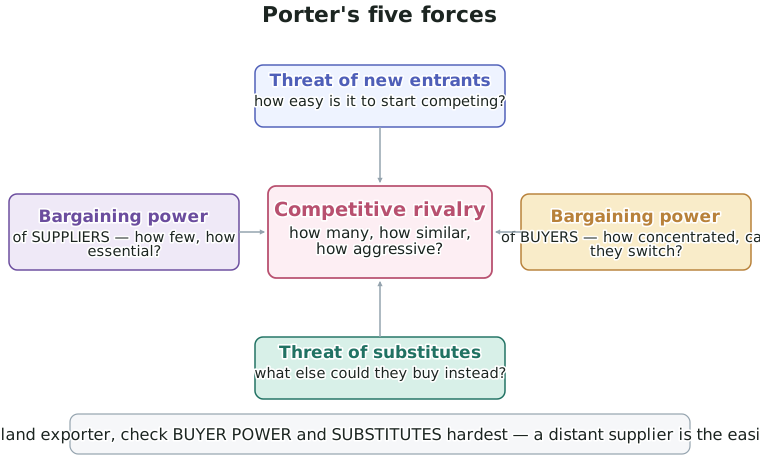
- Porter's five forces analyses how attractive a market is, by examining what limits the profit available in it.
| Force | The question | Stronger force means |
|---|---|---|
| Competitive rivalry | How many competitors, how similar, how aggressive? | Prices and margins pushed down |
| Threat of new entrants | How easy is it for others to start competing? | Profits attract competition and erode |
| Threat of substitutes | What else could a customer buy instead? | A ceiling on what you can charge |
| Bargaining power of buyers | How concentrated are the buyers, and can they switch easily? | Buyers dictate price and terms |
| Bargaining power of suppliers | How few are they, and how essential? | Suppliers take more of the margin |
- What it is for in a plan: it explains why the market is profitable or not, and points at the strategy. A market with powerful buyers calls for differentiation or for spreading the customer base; a market with low entry barriers calls for building something a new entrant cannot copy quickly.
- Applied to a New Zealand exporter, the forces to check hardest are usually buyer power — large offshore retailers — and substitutes, since a distant supplier is the easiest one to replace.
Marketing assumptions
- Marketing assumptions are the things the plan takes to be true but cannot prove. The standard names them as part of the market situation, and they are the section candidates most often omit.
- Assumptions worth stating:
- the market will grow, stay flat or decline at roughly a stated rate
- competitors will not launch a directly comparable product during the plan period
- the exchange rate will stay within a stated range
- the distributor will accept the product and give it the shelf space discussed
- production capacity will be available to meet the forecast
- input costs will rise by no more than a stated amount
- no new regulation will affect the product in the plan period
- Why they matter: every assumption is a risk, and each one is where a contingency plan comes from. Writing "we assume the exchange rate stays within 5% of today's level" tells you exactly what the contingency plan must cover.