Sales forecasting and contingency plans
Why the plan needs a forecast
- The standard names forecasting as part of the marketing strategy. A forecast is the bridge between the objectives and the budget: it says how much will be sold, so the business can work out what it can afford to spend and whether the plan is worth doing.
- A forecast is not a target. It is a best estimate with its reasoning attached — and it is only as good as the assumptions it rests on, which is why the assumptions section comes first.
How to build one
- Method 1 — build up from distribution. The most defensible method for a new product in a new market:
- number of stockists × average units sold per stockist per month × months × price
- Every one of those figures can be argued from research or from the business's existing markets.
- Method 2 — top down from market share. Total market size × the share you expect to win. Quick, and easy to make wildly optimistic; a new entrant taking 5% of a market in year one is usually fantasy.
- Method 3 — from history. For an existing product, last year's sales adjusted for the market's growth and the effect of the plan. The most reliable of the three, and only available if you have history.
- Whichever method, phase it. Sales do not begin at full rate on day one. Show the build as distribution grows, and show any seasonality.
Three scenarios
- A thorough plan forecasts three cases, not one:
- Most likely — the central estimate the plan is built on
- Optimistic — what happens if the assumptions are better than expected
- Pessimistic — what happens if they are worse
- The pessimistic case is the one that matters, because it answers the question the business actually cares about: can we survive being wrong?
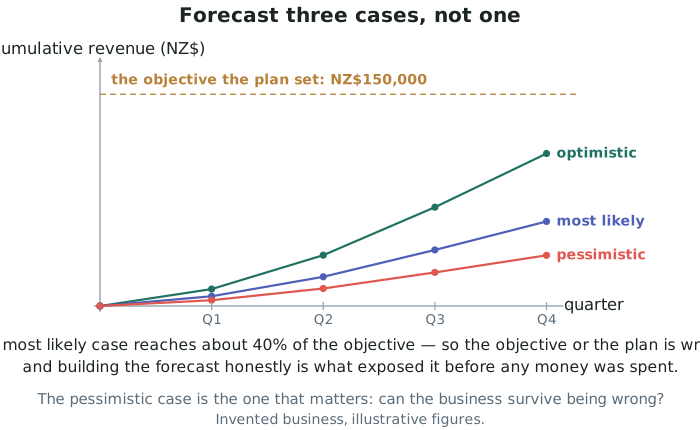
- Drawing the three cases against the objective is what makes the gap visible. In the graph above the most likely case lands nowhere near the line the plan committed to — and that is a problem worth finding before the budget is spent, not after.
Worked ExampleBuilding a first-year sales forecast
Puhoi Peak Chocolate (invented business, illustrative figures) plans to launch in Australia. Its research suggests a comparable premium bar sells about 25 units per store per month in a specialty grocery store. The plan targets 60 stores by 31 March, Puhoi Peak receives A$4.20 per bar after distributor margin, and the plan assumes NZ$1 = A$0.92.
Build a first-year sales forecast, and check it against the objective of NZ$150,000.
Step 1 — Phase the distribution build
Stores are signed progressively over the first nine months, not all at once. Assume an average of 20 stores in the first quarter, 40 in the second, 55 in the third and 60 in the fourth.
Step 2 — Calculate units per quarter
Each quarter is three months, so units = average stores × 25 units × 3 months.
| Quarter | Average stores | Units |
|---|---|---|
| 1 | 20 | 1,500 |
| 2 | 40 | 3,000 |
| 3 | 55 | 4,125 |
| 4 | 60 | 4,500 |
| Total | 13,125 |
Step 3 — Convert to revenue
At A$4.20 received per unit:
13,125 × 4.20 = A$55,125
Converted at the plan's assumed rate of NZ$1 = A$0.92:
55,125 ÷ 0.92 = NZ$59,918
Step 4 — Sense-check against the objective
The plan's objective was NZ$150,000 in year one, and the forecast comes to about 40% of that. So either the objective or the plan is wrong. Options: target more stores, target higher-volume channels as well as specialty grocery, or revise the objective down to match what the distribution build can actually deliver.
Step 5 — State the pessimistic case
If stores sell 15 units a month rather than 25, revenue falls to 7,875 units × 4.20 = A$33,075, about NZ$35,951. The plan must be affordable at that level, or it is a bet rather than a plan.
What this worked example is really showing. The value of a forecast is not the number. It is that building one honestly exposed an objective the business could not have hit — and it exposed it before any money was spent.
Contingency plans
- A contingency plan says what the business will do if a stated assumption proves wrong. The standard names it as part of the marketing strategy.
- Write one for each significant assumption. Each contingency has three parts:
- The trigger — a specific, observable condition, with a number and a date. "If fewer than 30 stores are signed by 31 January…"
- The response — what will be done. "…redirect the trade show budget into a distributor incentive and appoint a second agent for Melbourne."
- The consequence — what the plan then expects. "…which is forecast to recover the distribution build by the end of Q3, at the cost of the Q4 consumer sampling programme."
- Contingencies worth having in almost any plan:
- distribution builds more slowly than forecast
- sell-through per store is below forecast
- a competitor launches a directly comparable product
- the exchange rate moves against the business
- production cannot meet demand, if the plan succeeds faster than expected
- a key distributor withdraws