The Ansoff matrix and the marketing mix
The Ansoff matrix
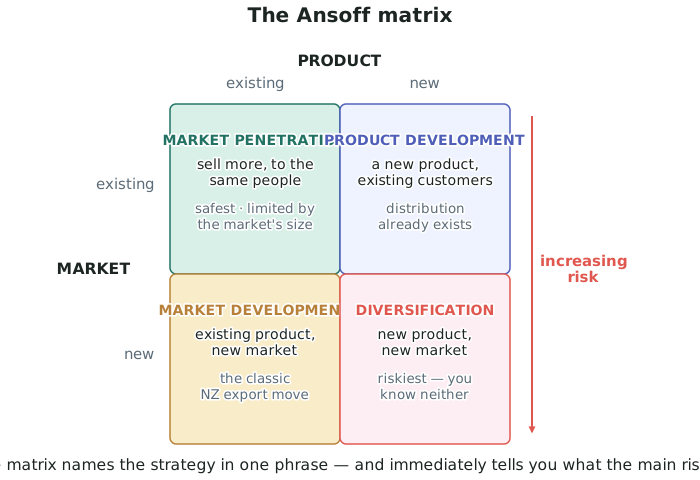
- The Ansoff matrix sets out the four ways a business can grow, according to whether the product and the market are existing or new.
| Existing market | New market | |
|---|---|---|
| Existing product | Market penetration — sell more of what you have, to the people you already sell to | Market development — take the existing product into a new market or segment |
| New product | Product development — sell a new product to your existing customers | Diversification — a new product in a new market |
- Risk rises as you move away from the top-left corner. Market penetration is the safest because the business already knows the product and the customers; diversification is the riskiest because it knows neither.
- What it is for in the plan: it names the strategy in one phrase and immediately tells you what the main risk is.
- Market penetration — cheapest and safest, but limited by the size of the existing market. Achieved by taking share from competitors, increasing usage, or improving retention.
- Market development — the classic New Zealand export strategy: a proven product taken to a new country. The risk is that the new market's customers are not like the old ones.
- Product development — uses the existing customer relationship, so distribution is already there. The risk is development cost and cannibalisation.
- Diversification — highest risk, and usually only justified when the existing market is declining.
Segmentation, targeting and positioning
- Before the mix, three decisions:
- Segmentation — divide the market into groups that behave differently. By demographics, location, lifestyle, values, usage or benefit sought.
- Targeting — choose which segment or segments the plan aims at. A plan that targets "everyone" targets nobody, and its promotion cannot be written.
- Positioning — decide what the product should mean to that segment, relative to competitors. Position on the benefit that matters to them and that the business can actually deliver.
The marketing mix
- The marketing mix is the set of decisions that deliver the positioning. The four elements must be consistent with each other and with the positioning — that consistency is what makes a strategy sound.
- Product.
- Features, quality, range, packaging, branding, guarantee, after-sales support.
- For a new market: what has to change? Size, format, flavour, labelling language, ingredient compliance, certification.
- Price.
- The price level relative to competitors, and the pricing method:
- Cost-plus — add a margin to cost. Simple; ignores what the customer will pay.
- Competitive — price against rivals. Safe; invites a price war.
- Premium — price high to signal quality. Requires the product to justify it.
- Penetration — price low to gain share fast, then raise. Risky, because raising a price is hard.
- Skimming — price high at launch to recover development costs, then lower. Works where early buyers value being first.
- Remember the channel margins: the price the exporter receives is not the shelf price. A distributor and a retailer each take a margin, and the retail price must still be competitive after both.
- The price level relative to competitors, and the pricing method:
- Place.
- Which channels: direct online, distributor, wholesaler, specialty retail, supermarket, food service.
- Each has a different margin, a different volume and a different amount of control over how the product is presented.
- Promotion.
- Advertising, digital and social, public relations, in-store sampling and display, trade shows, sales promotion, packaging itself.
- Choose channels by where the target segment actually is, not by what is cheapest or most familiar.
- For a business entering a market, trade promotion — persuading distributors and retailers to stock the product — usually has to come before consumer promotion. There is no point creating demand for a product nobody can buy.