The marketing audit
What an audit is for
- A marketing audit is an honest review of what the business is doing now and how well it is working, before deciding what to do next.
- It is a factual stocktake, not an opinion. Every claim in it should rest on something — sales data, research, a competitor's price list, a customer complaint log.
- The audit is what makes the rest of the plan credible: a strategy built on a guess about the current position is a guess.
What to audit
- The product.
- What is in the range, what each product is for, and how each is performing.
- Where each sits in its life cycle — new, growing, mature, declining.
- What makes it different from competitors, in the customer's terms.
- Price.
- Current prices and margins, discounting practice, and prices relative to competitors.
- Whether the price matches the positioning — a premium claim at a mid-market price confuses customers.
- Place (distribution).
- Which channels the product sells through, what share each contributes, and where it is not available.
- Channel costs and margins, and how much control the business has over how the product is presented.
- Promotion.
- What was spent on what, and what each activity produced.
- Which messages are being used, and whether they match the positioning.
- The customers.
- Who buys, how often, how much, and which segments are growing or shrinking.
- Why they buy — and why lapsed customers stopped.
- The competitors.
- Who they are, what they charge, how they position, what they have launched recently.
- The results.
- Sales by product, channel and market, over time. Market share. Margin. Return on marketing spend.
Market research in the audit
- The guide names market research (size, market share, targets, segments) as part of this standard. Here research serves the audit, rather than being the assessed task in itself.
- Use secondary research first — internal sales data, published market statistics, competitor material, industry reports — because it is fast and free, and it tells you what you still need to find out.
- Then use primary research to fill the specific gaps: what customers think of the product, what they would pay, which segment responds to which message.
- Four figures the plan needs and the audit should establish:
- Market size — total sales of this kind of product in this market
- Market share — the business's sales as a percentage of that
- Segments — the distinct groups within the market, and their size
- Target — which segment or segments the plan will aim at
The Boston matrix
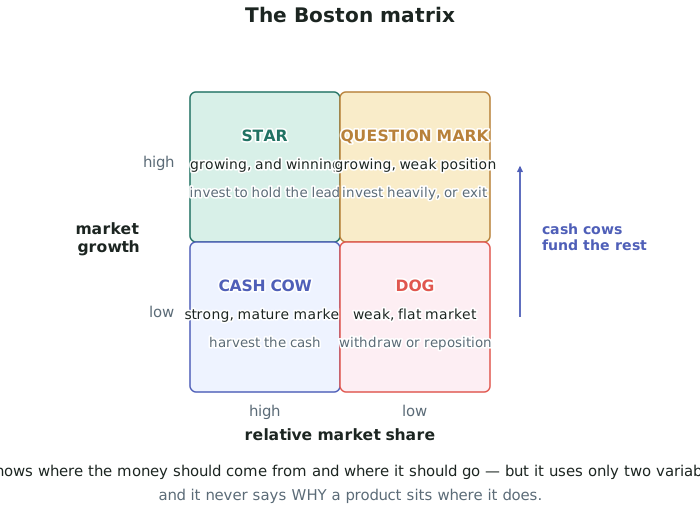
- The Boston matrix classifies each product in the range on two axes: market growth (is the market expanding?) and relative market share (is this product strong within it?).
| High market share | Low market share | |
|---|---|---|
| High market growth | Star — growing and winning; invest to hold the position | Question mark — growing market, weak position; invest heavily or exit |
| Low market growth | Cash cow — strong position in a mature market; harvest the cash | Dog — weak position in a flat market; withdraw or reposition |
- What it is for in a marketing plan: it shows where the money should come from and where it should go. Cash cows fund stars and question marks; dogs are candidates for withdrawal.
- Its limits, worth stating at Excellence: it uses only two variables, "growth" and "share" have to be defined and the answer changes with the definition, and it says nothing about why a product is where it is.