Job, batch and flow production
What a production process is
- The production process is the method a business uses to turn inputs (materials, labour, equipment) into the good or service it sells.
- Three methods are examined at Level 2: job, batch and flow.
- The choice is driven by two things: how many units the business makes, and how different each unit has to be.
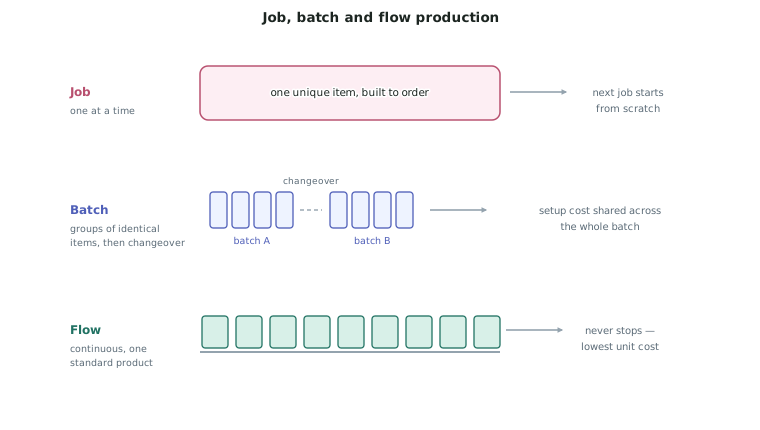
Job production
- Job production makes one item at a time, built to the specific requirements of that job, before starting the next.
- The product is unique or highly customised: a designed and built home, a wedding cake, a bespoke piece of furniture, a consulting report, a haircut.
| Advantages of job production | Disadvantages of job production |
|---|---|
| The product matches exactly what the customer asked for, so a premium price can be charged | High unit cost — labour and setup are spread over one item |
| Motivating for skilled staff, who complete a whole piece of work | Slow, so the business can only serve a limited number of customers |
| Easy to change the specification part-way through | Requires skilled, expensive labour that is hard to replace |
| Suits low volumes without needing expensive machinery | Errors are costly, because there is no second identical unit to compare against |
Batch production
- Batch production makes a group of identical items together, completing each stage for the whole group before moving on. When the batch is finished, the equipment is changed over for the next batch.
- Typical of bakeries, paint manufacturers, clothing makers and food processors: a run of one flavour, size or colour, then a switch.
| Advantages of batch production | Disadvantages of batch production |
|---|---|
| Lower unit costs than job production, because setup is spread across the batch | Changeover time between batches is time the equipment is not producing |
| The business can still offer variety — different sizes, flavours or colours | Work-in-progress builds up between stages, tying up money in stock |
| Machinery and staff are used more consistently than in job production | Less flexible than job production if a customer wants a one-off change |
| Quality can be checked batch by batch, isolating a fault to one run | A fault found late may spoil an entire batch, not one item |
Flow production
- Flow production makes a single standardised product continuously, each unit moving from stage to stage without stopping.
- Typical of dairy processing, bottling plants, packaging lines and vehicle assembly.
| Advantages of flow production | Disadvantages of flow production |
|---|---|
| The lowest unit cost of the three, because fixed costs are spread over huge volumes | Very high setup cost — the line and machinery must be bought before anything is sold |
| Output is consistent, which supports a reliable quality standard | Almost no flexibility: changing the product may mean rebuilding the line |
| Production is fast and can run continuously | A breakdown at one point stops the entire line |
| Low-skilled labour can be used, since each task is simple and repeated | Repetitive work demotivates staff, raising turnover and error rates |
Choosing the right process
| If the business… | Use |
|---|---|
| Sells a unique product to each customer | Job |
| Sells variety in reasonable volumes | Batch |
| Sells one standard product in very high volumes | Flow |
- The trade-off is always the same: flexibility costs money, and low unit cost costs flexibility.
Worked ExampleWhich process, and what it costs to be wrong
Ata Bakehouse (an invented Hamilton bakery) supplies supermarkets. It currently uses batch production, running one bread type at a time: 600 loaves per batch, with a 45-minute changeover between batches. It runs 8 batches a day.
A consultant suggests moving to flow production — one bread type, made continuously, with no changeover at all.
Explain what the bakery would gain, what it would lose, and what the decision depends on.
Step 1 — Work out what changeovers are costing
8 batches a day means 7 changeovers between them.
7 × 45 minutes = 315 minutes, or 5 hours 15 minutes a day when the plant is staffed but producing nothing.
That is the cost the consultant is aiming at: over five hours of paid production time recovered every day.
Step 2 — Work out what flow production would gain
With no changeovers, those 5¼ hours become production time. At the batch rate of 600 loaves per 45-minute changeover-equivalent, the extra output is substantial, and every extra loaf carries no additional setup cost — so the unit cost of each loaf falls.
Lower unit cost means the bakery can either widen its margin or hold its price below a competitor's.
Step 3 — Work out what it would lose
Flow production makes one standardised product. The bakery currently sells eight bread types, and supermarkets buy from it because it can supply a range from one delivery.
Moving to flow means the bakery either drops seven products, or buys seven separate lines it cannot afford.
Step 4 — Identify what the decision actually turns on
The decision turns on why customers buy from this bakery.
- If supermarkets buy on price for one high-volume line — a standard white sandwich loaf — flow production for that line alone is justified, because the volume is there to absorb the setup cost.
- If they buy on range, flow production destroys the thing being bought, and the changeover time is the price of the product mix that wins the contract.
The right answer is not "flow production is cheaper". It is: run flow production for the one line with the volume to justify it, and keep batch production for the range.