Economies of scale
What economies of scale are
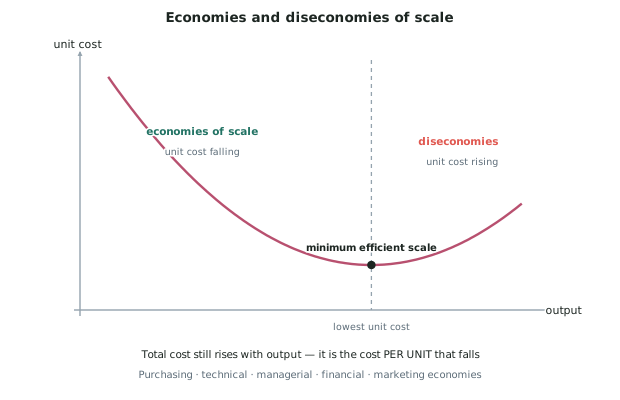
- Economies of scale are the reductions in unit cost a business achieves as it produces on a larger scale.
- Larger output does not make total costs fall — total costs rise. What falls is the cost per unit, because some costs do not grow in proportion to output.
The main types
Purchasing (bulk-buying) economies.
- Buying materials in large quantities earns a discount per unit, because the supplier's own costs of selling and delivering fall.
- Usually the largest and most examinable economy for a New Zealand retailer or manufacturer.
Technical economies.
- Large-scale machinery and automated plant are only affordable — and only fully used — at high output.
- A packing line that costs the same to run whether it fills 1,000 or 10,000 units a day gives a much lower cost per unit at 10,000.
Managerial economies.
- A large business can employ specialists — an accountant, an HR manager, a logistics planner — whose salary is spread over far more units than in a small firm where one owner does everything, badly.
Financial economies.
- Large businesses are seen as lower risk by lenders and can borrow more cheaply, so the interest cost carried by each unit is lower.
Marketing economies.
- The cost of a campaign is roughly the same whether it promotes 100,000 or 1,000,000 units, so the advertising cost per unit falls as sales rise.
Diseconomies of scale
- Past a certain size, unit costs start rising again. These are diseconomies of scale.
- Communication — more layers and more people means slower, more distorted information.
- Coordination — more sites and departments are harder to keep aligned, and duplicated effort appears.
- Motivation — staff feel anonymous in a very large organisation, so effort and commitment fall.
- The lowest point of the curve is the minimum efficient scale: the output at which unit cost is lowest.
Why it matters
- Economies of scale are the reason a large business can undercut a small one on price and still make money.
- They are also why losing volume is dangerous: if output falls, the same fixed costs are spread over fewer units, unit costs rise, and the business's price advantage disappears just as sales are falling.
- Rising input costs work the same way. When freight charges rise, the cost of moving each unit rises, which offsets the purchasing economies the business had earned by ordering in bulk.
Worked ExampleWhat bulk buying is actually worth
Kauri Supply Co (invented) makes outdoor furniture. It currently produces 5,000 units a year and buys timber at $60 per unit. Its fixed costs are $400,000 a year, and other variable costs are $25 per unit.
A supplier offers timber at $52 per unit for orders covering 8,000 units or more. Demand exists for 8,000 units at the current price.
Calculate the unit cost at each output level and explain the effect on the business.
Step 1 — Unit cost at 5,000 units
Variable cost per unit = timber + other = $60 + $25 = $85
Fixed cost per unit = $400,000 ÷ 5,000 = $80
Step 2 — Unit cost at 8,000 units
Variable cost per unit = $52 + $25 = $77 (the purchasing economy)
Fixed cost per unit = $400,000 ÷ 8,000 = $50 (the technical/fixed-cost spreading)
Step 3 — Separate the two effects
The unit cost has fallen by $38. That is two different economies, and a good answer separates them:
- Purchasing economy: $60 → $52 = $8 per unit from the bulk discount.
- Spreading fixed costs: $80 → $50 = $30 per unit from producing more with the same fixed costs.
Most of the saving here is not the discount at all — it is the fixed costs being spread over 3,000 more units.
Step 4 — State what it lets the business do
At $127 instead of $165, Kauri Supply can hold its price and earn $38 more profit on every unit, or cut its price to take market share from a smaller competitor that cannot reach 8,000 units and therefore cannot reach this cost.
Unit cost falls from $165 to $127 — a fall of 23%.