Transformations of graphs
What a transformation does
- A transformation changes an existing graph in a predictable way — it slides, flips or stretches the whole curve without changing its basic family.
- Learn these once and they apply to every graph: parabola, cubic, exponential or hyperbola.
Translations (sliding the graph)
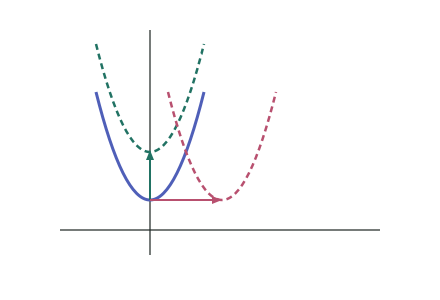
- — slides the graph up by (or down if is negative). It changes the height, so the whole curve moves vertically.
- — slides the graph right by (or left if is negative).
- Watch the sign: moves right 3, moves left 3 — the shift is the opposite sign to the number with .
Reflections (flipping the graph)
- — reflects the graph in the -axis (flips it upside down); every swaps sign.
- — reflects the graph in the -axis (flips it left–right).
Stretches (scaling the graph)
- — a vertical stretch by a factor of : every -value is multiplied by , so the graph is pulled taller (if ) or squashed (if ).
- This is exactly what the in did to a parabola — the same idea works for any .
Combining transformations
- A single equation can pack in several transformations. Read them off the standard shape :
- — vertical stretch / reflection (if negative),
- — horizontal slide,
- — vertical slide.
Describe how the graph of is obtained from , and state its vertex.
Step 1 — Read the horizontal shift
The "" means slide the base parabola right by 2.
Step 2 — Read the vertical shift
The "" means slide it up by 3.
Step 3 — Combine and state the vertex
Starting from (vertex at the origin), moving right 2 and up 3 puts the vertex at . The parabola keeps its shape and upward direction.
The graph of is reflected in the -axis and then moved up 5. Write the new equation and give its horizontal asymptote.
Step 1 — Reflect in the -axis
Reflecting gives (every height flips sign).
Step 2 — Move up 5
Adding 5: .
Step 3 — Asymptote
The original asymptote also moves up 5, so the new asymptote is ; the curve now approaches from below.
Test yourself
Practice by grade
One question each at Achieved, Merit and Excellence. Have a go, then compare with the model answer.
Describe the transformation that takes to .
The graph of is translated to . Describe the two moves and state where the point on ends up.
The parabola is reflected in the -axis, stretched vertically by a factor of 2, then moved up 8. Write the resulting equation and find where it crosses the -axis.