Cubic graphs
What a cubic looks like
- A cubic function has as its highest power, e.g. .
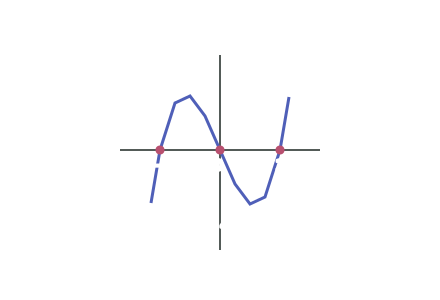
- Its graph is a smooth curve with a distinctive "S" bend: it can rise, dip, then rise again.
- A cubic can cross the -axis once, twice or three times, so it has up to three roots.
- The ends point in opposite directions: for a positive coefficient the curve comes up from the bottom-left and heads up to the top-right.
Reading roots from a factored cubic
- If a cubic is written as a product of factors, each factor gives a root — just like a quadratic:
- Set each factor to zero to find where the curve meets the -axis.
- A repeated factor (e.g. ) means the curve touches the axis there instead of crossing it.
The -intercept of a cubic
- As always, set and read off .
- From factored form, that is — just multiply the constants.
Sketch , showing the intercepts.
Step 1 — Roots (set )
Each factor zero gives — three -intercepts.
Step 2 — -intercept (set )
Step 3 — Shape
The coefficient is positive, so the curve rises from the bottom-left, weaves through , and , crosses the -axis at , and heads up to the top-right.
Test yourself
Practice by grade
One question each at Achieved, Merit and Excellence. Have a go, then compare with the model answer.
Achieved
Write down the roots of .
Merit
Find the roots and the -intercept of .
Excellence
A cubic has roots at , (touching the axis) and passes through . Find its equation in the form .