Reciprocal graphs (hyperbolas)
What a reciprocal graph is
- A reciprocal function has the variable in the denominator, e.g. .
- Its graph is a hyperbola: two separate curved branches in opposite corners of the grid.
- As gets large, gets small; as gets small (near zero), gets huge.
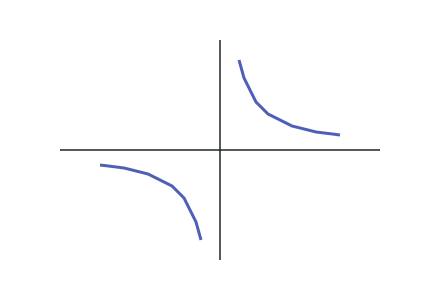
Asymptotes and the missing point
- has two asymptotes:
- the -axis () — you cannot divide by zero, so the graph never touches it.
- the -axis () — the branches flatten toward it but never reach it.
- Because is not allowed, the domain is all real except , and the range is all real except .
The effect of
- A larger pushes the branches further out from the origin; a smaller pulls them in.
- If is negative, the branches sit in the other pair of opposite corners (top-left and bottom-right).
The time hours to travel 120 km at speed km/h is . Find the time at km/h and at km/h, and explain the shape of the graph.
Step 1 — Evaluate at each speed
Step 2 — Interpret the shape
As speed increases, time decreases — the branch falls toward the asymptote but never reaches it (you can never take zero time). As speed approaches , the time shoots up toward the vertical asymptote .
Test yourself
Practice by grade
One question each at Achieved, Merit and Excellence. Have a go, then compare with the model answer.
For , find when and when .
State the equations of the two asymptotes of and the value of that is excluded from the domain.
A rectangle must enclose a fixed area of m². Its height depends on its width by . Explain why the graph is a hyperbola and why neither nor can be zero, and find the width that makes the rectangle a square.