Parabolas (quadratic graphs)
What a parabola is
- A parabola is the graph of a quadratic function — one with an term as its highest power.
- Its equation can be written in a few useful forms:
- General form .
- Factored form — best for reading the roots and .
- Vertex form — best for reading the vertex .
What the number does
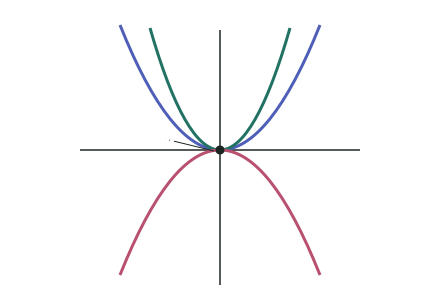
- controls the direction and width:
- ⇒ the parabola opens upward (a "smile", with a minimum).
- ⇒ it opens downward (a "frown", with a maximum).
- The larger , the narrower the parabola; a small makes it wide.
Finding the vertex
- The vertex sits on the axis of symmetry, exactly halfway between the roots:
- Substitute that back into the equation to get the vertex's -value.
- From vertex form you can read the vertex directly as .
Sketching a parabola
- Find the -intercept (set ).
- Find the -intercepts / roots (set and factorise, or use the quadratic formula).
- Find the vertex (midpoint of the roots, then substitute).
- Decide the direction from the sign of , then draw a smooth symmetric curve through the points.
Sketch , showing the intercepts and the vertex.
Step 1 — Intercepts
-intercept (): . Roots (): , so and .
Step 2 — Vertex (midpoint of roots, then substitute)
Vertex .
Step 3 — Direction and sketch
, so the parabola opens upward with a minimum at , passing through , and .
Test yourself
Practice by grade
One question each at Achieved, Merit and Excellence. Have a go, then compare with the model answer.
Achieved
State the vertex of and say whether it is a maximum or minimum.
Merit
Find the roots and vertex of .
Excellence
A ball's height (m) after seconds is . Find the greatest height reached and when, and how long the ball is in the air. Interpret each answer.