Key features of graphs
Why features matter
- Every graph can be described by a short list of key features — the landmarks that tell you its shape and where it sits.
- Naming these features is how you connect an equation to its picture, which is exactly what this standard rewards.
Intercepts
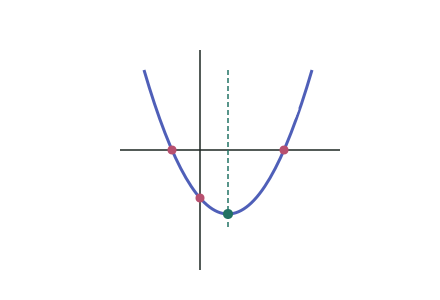
- The -intercepts are where the graph crosses the -axis. Here , so you set and solve for .
- For a curve these are also called the roots or zeros.
- The -intercept is where the graph crosses the -axis. Here , so you set and read off .
- A graph has at most one -intercept (a function gives one for each ), but can have several -intercepts.
Turning points
- A turning point is where a curve changes direction — from going up to going down, or the reverse.
- A minimum turning point is the lowest point of a dip; a maximum is the highest point of a hump.
- A parabola has exactly one turning point (its vertex); a cubic can have two (a maximum and a minimum) or none.
Axis of symmetry
- Some graphs have an axis of symmetry — a mirror line where one side is the reflection of the other.
- A parabola is symmetric about the vertical line through its vertex.
Asymptotes
- An asymptote is a line the graph gets closer and closer to but never touches.
- Exponential and reciprocal graphs have asymptotes; parabolas and cubics do not.
Domain and range
- The domain is the set of -values the graph uses (how far left–right it extends).
- The range is the set of -values it takes (how far down–up it reaches).
- Example — for the domain is all real numbers, but the range is , because a square is never negative.
For the parabola , find the -intercept and the -intercepts.
Step 1 — -intercept: set
Step 2 — -intercepts: set and factorise
Step 3 — Solve each bracket
So the curve cuts the -axis at and the -axis at and .
Test yourself
Practice by grade
One question each at Achieved, Merit and Excellence. Have a go, then compare with the model answer.
Achieved
Find the -intercept of .
Merit
Find the -intercepts of and state the axis of symmetry.
Excellence
State the range of , justifying your answer.