The three groups of natural processes
What a process is, and why 2025 printed the definition
- A process is a sequence of actions or changes that produces a result. The 2025 paper printed that definition in the instructions, which means you are marked on using the idea, not on reciting it.
- A process has a mechanism, a rate and a result. An answer that names a process without giving all three is a label, not an explanation.
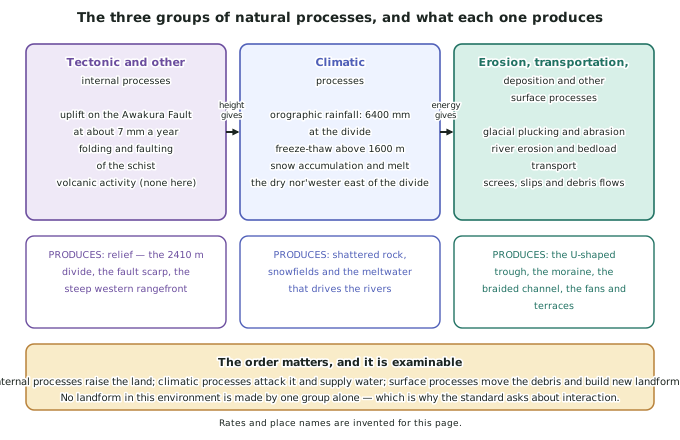
- The standard groups natural processes into three, and only three: climatic; tectonic and other internal; erosion, transportation, deposition and other surface processes.
- Learn the grouping, because the stem often names the group. Explain how ONE group of natural processes has shaped the environment is a real stem shape, and answering with a process from the wrong group scores nothing.
- Processes are what separate this standard from a description. The characteristics are the nouns; the processes are the verbs that made them.
Tectonic and other internal processes
- Internal processes are driven by energy from inside the Earth — plate movement, faulting, folding, uplift, volcanism, earthquakes.
- What they produce is relief. No internal process, no height; no height, no gradient for any other process to work down.
- In the invented Awakura environment the internal process is uplift on the Awakura Fault at about 7 mm a year, folding and faulting the underlying schist. There is no volcanic activity in this environment, and saying so is better than inventing some.
- Quote the rate, because the rate is the argument. 7 mm a year is 7 km in a million years — far more than the present 2,410 m, which tells you erosion has removed most of what was raised.
- Internal processes act over the longest timescale of the three, and are the slowest to reverse. That is why they come first in any sequence.
Climatic processes
- Climatic processes are driven by energy from the Sun and by the movement of air and water — precipitation, temperature change, wind, freeze-thaw, snow accumulation and melt.
- What they produce is energy and water for everything else, plus direct breakdown of rock.
- In Awakura: orographic rainfall reaching 6,400 mm a year at the divide; freeze-thaw above about 1,600 m, where the temperature crosses 0 °C repeatedly; snow accumulation and melt feeding the rivers each spring; and the dry, warming nor'wester east of the divide.
- Freeze-thaw is the process to name if you need a mechanism in full. Water enters a joint in the schist, freezes, expands by about 9 per cent, forces the joint wider, thaws, and the cycle repeats until the block detaches and falls to the scree below.
- Climatic processes are the fastest of the three, operating on daily and seasonal cycles, which is why their effects show up in a student's lifetime.
Erosion, transportation, deposition and other surface processes
- Surface processes move material from where internal processes raised it to where it comes to rest. They are the connectors of the system.
- Erosion detaches and removes: glacial plucking and abrasion carved the Awakura trough under about 700 m of ice; river erosion cuts the channel; mass movement delivers slips and debris flows off the trough walls.
- Transportation carries: the braided Awakura River moves a bedload of schist gravel east; the glacier carried rock frozen into its base.
- Deposition lays material down when energy falls: the terminal moraine that dams Lake Manaia, the alluvial fans at the trough wall, and the Pikitea river terraces.
- Weathering is not erosion, and the distinction is examinable. Weathering breaks rock in place; erosion removes it. Freeze-thaw is weathering; the scree slope it feeds is built by erosion and deposition.
The order matters, and it is examinable
- Internal processes raise the land. Climatic processes attack it and supply the water. Surface processes move the debris and build new landforms. That sentence is the spine of any process answer in this standard.
- No landform here is made by one group alone. Lake Manaia needs uplift (a valley to fill), a cold climate (ice to carve and to dump the moraine), and deposition (the moraine itself). That is exactly why the standard asks about interaction.
- Rates differ by orders of magnitude, and saying so is geographic terminology used well: uplift at 7 mm a year, glacial carving over tens of thousands of years, a debris flow in an afternoon.
- Name the group, then the process, then the mechanism, then the result. Four moves, in that order, every time.
Worked Example
Worked example
Name ONE natural process operating in a large natural environment you have studied. Explain how and why that process has shaped a landform in the environment.
Answer:
Step 1 — name the process and its group, because the naming line comes first.
The process is glacial erosion by plucking and abrasion, which belongs to the group of erosion, transportation, deposition and other surface processes. The landform it shaped is the Awakura glacial trough.
Step 2 — give the mechanism for plucking.
Meltwater at the base of the ice enters joints in the schist and refreezes onto the glacier sole. As the ice moves forward, blocks that are frozen to it are pulled out of the bedrock. This works best on the down-glacier side of any bump, where pressure is lower and refreezing is easiest, so plucking steepens the back of every rise it passes.
Step 3 — give the mechanism for abrasion, because the two do different jobs.
The blocks that plucking removed are now carried in the base of the ice. Dragged across the bedrock under the weight of about 700 m of ice, they act like the grit on sandpaper, scratching and grinding the rock into fine rock flour and smoothing what plucking left rough.
Step 4 — explain how the two together produce the landform.
A river valley is V-shaped because a river only erodes along its channel. A glacier fills the whole valley, so plucking and abrasion attack the floor and both walls at once. Between roughly 90,000 and 14,000 years ago this widened and deepened the Awakura valley into a U-shaped trough with a flat floor and walls steeper than 45°.
Step 5 — answer the "why" by naming what made the process possible.
Glacial erosion only operated here because two other groups of processes set it up. Internal processes raised the divide to a height where ice could accumulate; climatic processes delivered the snowfall and the temperatures to turn it into 700 m of ice. The trough is the product of all three groups, not one.