How perceptions of the environment change over time
What a perception is in this standard
- Aspect 5 is how people's perceptions of the environment change over time, and it has appeared as a stem in its own right — usually as the second half of a question, after a group has already been named for aspect 4.
- A perception is not an opinion. It is what a group values the environment for, and it is built from their needs, their technology, their beliefs and their economic position.
- The test of a perception is that it explains behaviour. If you can name what a group valued and then point at the mark they left on the land, you have a perception. If you cannot, you have a guess.
- Perceptions change because the things that build them change — new technology, new economic conditions, new laws, new knowledge, new arrivals.
- The stem asks for change over time, so a single perception, however well described, cannot reach Achieved on this aspect. You need at least two points in time.
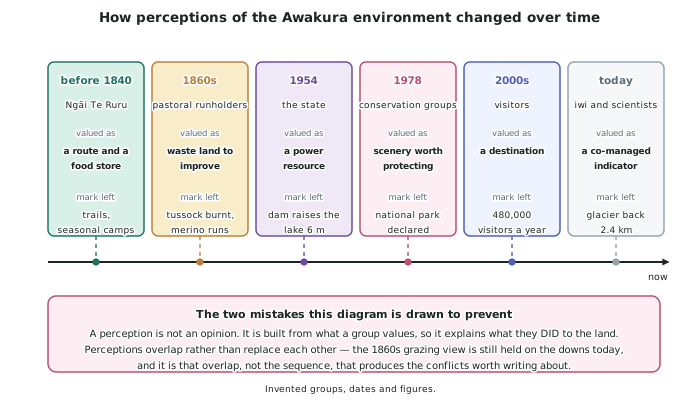
The Awakura sequence, and the mark each perception left
- Ngāi Te Ruru, before 1840 — the valley as a route and a food store. Valued for what it produced and what it connected. The mark left: trails over the pass and seasonal camps at the lake, but no permanent alteration of the vegetation or the rivers.
- Pastoral runholders, from the 1860s — the valley as waste land to improve. Land not producing income was seen as land not yet in use. The mark left: the tussock burnt on the Rangitoto Downs and merino runs established, a change still visible 160 years later.
- The state, 1954 — the valley as scenery worth protecting. Rarity and beauty became a national asset. The mark left: Awakura National Park declared, which stopped burning and grazing west of the boundary.
- The state again, 1978 — the valley as a power resource. Water and head became a national asset of a different kind. The mark left: the Manaia dam raised the lake 6 m.
- Today — the valley as a destination, an indicator and a co-managed place. 480,000 visitors a year; the glacier's 2.4 km of retreat since 1978 read as a climate signal; and co-management between iwi and the Crown restoring a perception that had been displaced.
- The 1954 and 1978 perceptions were held by the same institution 24 years apart, which shows that a perception belongs to a purpose, not only to a group.
The two mistakes this aspect punishes
- Mistake 1: treating the sequence as replacement. Perceptions overlap rather than succeed one another. The 1860s grazing view is still held on the downs today, alongside the conservation view held 40 km west.
- The overlap is where the marks are. Conflicts arise because two perceptions are held at the same time by different groups about the same place, not because one perception followed another.
- Mistake 2: describing perceptions without explaining what caused the change. Views changed over time is not an answer. Refrigerated shipping made merino wool profitable, so land that had been a route became land to improve is.
- Always give the driver. New technology, new law, new economic conditions, new scientific knowledge, or a new group arriving — one of those five is usually behind each shift.
- Attach a date to each perception. Undated perceptions cannot show change over time, which is the whole aspect.
Concepts that fit perceptions
- Perspectives — the concept is almost a synonym for this aspect, so use the word and distinguish the perspectives explicitly.
- Change — perceptions change faster than landforms and more slowly than weather, and saying where they sit on that scale is good use of terminology.
- Sustainability — different perceptions produce different answers to whether current use can continue, and that disagreement is itself geographic content.
- Environments — a perception is partly what makes a place an environment to somebody: the same valley is a catchment, a park and a food store depending on who is looking.
Structuring the answer
- Two perceptions minimum, three is comfortable. Any more and you will run out of time before you explain any of them.
- For each one: who, when, what they valued, what they did, and what evidence remains. Five moves, and the last two are where the marks are.
- Then explain the shift between them, naming the driver.
- Then, for Excellence, explain the overlap — who still holds the earlier perception, and what conflict that produces now.
Worked Example
Worked example
Name TWO groups who have different perceptions of a large natural environment you have studied. Explain how and why their perceptions have changed over time.
Answer:
Step 1 — name the groups and date each perception, because undated perceptions cannot show change.
Group 1: Ngāi Te Ruru, before 1840 and again today. Group 2: the state, from 1954 onwards.
Step 2 — group 1, with the mark left on the land.
Before 1840, Ngāi Te Ruru valued Awakura as a route and a food store — a way over the divide and a place of seasonal harvest. The mark left is trails over the pass and seasonal camp sites at the head of the lake, and no lasting change to the vegetation, because the value did not require any.
Step 3 — the change, and its driver.
From the 1860s this perception was displaced rather than abandoned — the driver was not a change of mind but a change of control, as pastoral runs and later the park and the dam took over decisions about the valley. Today it is being re-established through the co-management arrangement, and the driver there is legal: settlement processes that returned iwi to the decision-making table.
Step 4 — group 2, and note that one group can hold two perceptions.
The state's perception has itself changed twice. In 1954 it declared Awakura National Park, valuing the environment as scenery worth protecting, and the mark left is a boundary that stopped burning and grazing. In 1978 the same state consented to raising Lake Manaia by 6 m for generation, valuing it as a power resource. The mark left is 6 m of drowned shoreline and an altered downstream flow regime.
Step 5 — explain what that shows, which is the step most answers miss.
The two state perceptions are only 24 years apart and were not a reversal. They are two purposes held at once by one institution, which is why the park boundary and the dam consent could coexist. A perception belongs to a purpose, not simply to a group.
Step 6 — finish on the overlap, not the sequence.
None of these perceptions has disappeared. Grazing, protection, generation, tourism and iwi values are all held simultaneously in 2026, by different groups, about the same valley. It is that overlap, not the sequence, that produces the disputes over lake levels and access — and any answer that presents the perceptions as replacing one another cannot explain why there is any conflict left to have.