Cultural factors contributing to differences in development
What counts as a cultural factor
- A cultural factor is any factor caused by people. That is deliberately wide, and the paper's own examples show the range: laws, beliefs, trade, globalisation, colonisation and political systems.
- The useful groups are four: history, especially colonisation; trade and globalisation; government, law, debt and conflict; and beliefs, values and social structure.
- They can change quickly, unlike natural factors: a law, a tariff or a peace agreement can alter the cost of production in a year.
- They also compound, altering the conditions that produced them, so differences created culturally tend to persist or widen without anything new happening.
- Write about processes, not about peoples. The standard is about the process — colonisation, trade, migration, urbanisation — and how it operates. Attributing a country's development to the character of its population is neither geography nor accurate.
History and colonisation
- Colonisation is named on the paper's own list of factors, so it is examinable content, and it is best explained through its mechanisms, not as a general grievance.
- Colonial economies were built to export raw materials. Roads and railways typically ran from a resource to a port rather than between the country's own regions, and that geography of movement is expensive to reverse and often still in place. Processing usually happened elsewhere, so the skills, plant and capital of manufacturing accumulated in one place and not the other.
- Land ownership and legal systems were reorganised, and unresolved title makes it hard to invest in land you cannot securely hold.
- Borders were often drawn without regard to who lived where, leaving some states administering populations with little shared history.
- The honest limit. Countries with similar colonial histories now sit at very different stages, so the mechanism, not the fact, is what explains a difference.
Trade, globalisation and the terms of exchange
- What a country sells matters more than how much. A producer of unprocessed goods earns a small share of the final price and cannot influence it.
- Commodity prices are set on world markets, so a country dependent on one or two exports faces income that swings independently of anything it does — and no government can plan a ten-year health programme on revenue that halves without warning.
- Value is added at each processing step, and the steps are usually in different countries. Turning beans into chocolate multiplies the value many times, and almost all of that increase accrues where the processing happens.
- Tariffs commonly rise with the level of processing, which makes moving up the chain harder than the raw price difference suggests.
- Globalisation is not one-directional. It brings investment, technology, employment and export markets; it also brings competition that can close local industry, and profits that leave.
- A transnational company's investment is genuinely useful and genuinely conditional: it can relocate, and that possibility shapes wages and regulation before it ever happens.
Government, law, debt and conflict
- Government decides how a given amount of revenue becomes development, or does not. Two countries with identical income can differ enormously in literacy and infant mortality according to what is funded.
- Law matters through certainty. Secure title, enforceable contracts and predictable taxation let a household or business invest in something that pays back later. Corruption works the other way: money allocated and not delivered buys nothing, and the loss falls on people with no alternative provider.
- Debt converts a past decision into a present constraint: repayments are the first call on revenue, so schools and clinics are funded from what is left.
- Conflict is the fastest way to reverse development — infrastructure destroyed, people displaced, schools closed, certainty removed — and its effects continue long after it ends.
Beliefs, values, and how cultural differences persist
- Beliefs and values are on the paper's list, and act through decisions repeated at household scale: how long children stay in school, at what age people marry, how many children a family plans, and who does paid work.
- Expectations about girls' education and women's paid work are the most studied of these, because raising girls' schooling is associated with later marriage, smaller families and lower infant mortality at once.
- Values are not fixed and are not a ranking. They respond to circumstances — the demographic transition is largely family size changing as child survival changes — so describing them as a permanent trait is wrong and unmarkable.
- Cultural factors compound, which is why differences persist. Skills, capital and infrastructure accumulate where they already are: a region with trained workers attracts the plant that trains more; a region without them does not.
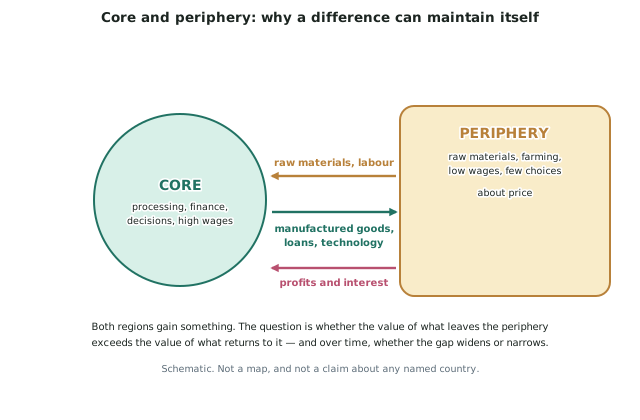
- The term is cumulative causation — an initial advantage feeding conditions that reinforce it. The core–periphery diagram above is its spatial version: both regions gain something, and the question is whether the value leaving the periphery exceeds the value returning.
- This is the strongest general argument in the standard: a development difference does not need a continuing cause once it exists, because the ordinary operation of trade, investment and migration reproduces it.
Worked Example
Worked example
Name ONE cultural factor and explain how it contributes to differences in development. Support your answer with case study evidence.
Answer:
Step 1 — name the factor precisely, and state the position.
The factor is dependence on unprocessed commodity exports in invented Aluvia — a trade factor, and cultural because the pattern was made and is maintained by people. About 74 per cent of exports leave unprocessed, and cocoa beans alone are about 31 per cent of export earnings.
Step 2 — first mechanism: where the value is added.
A tonne of beans sells for a fraction of the value of the chocolate made from it. Roasting, grinding, blending and branding all happen elsewhere, and each step adds value where it happens. Aluvia captures the first and smallest step.
Step 3 — second mechanism: who sets the price.
The bean price is set on a world market, and Aluvia's export earnings have varied by about ±28 per cent year to year with no change in output. No government can commit to a ten-year clinic programme on revenue that behaves like that, so spending stays short-term even when total revenue is adequate.
Step 4 — third mechanism: why moving up the chain is hard.
Aluvia's main markets apply a low tariff on beans and a higher one on processed cocoa, so a domestic plant would face a cost disadvantage the raw exporter does not, and would need workers with more schooling than the mean of 4.6 years supplies. The factor protects itself, which is why it persists.
Step 5 — connect it to the measured difference, and state the limit.
Compare Cordas, where 78 per cent of workers are in the tertiary sector and exports are mostly processed goods and services. Cordas's US$46,000 per person against Aluvia's US$2,200 is not explained by how hard people work or by how much cocoa exists, but substantially by which step of the chain each country occupies.
Unlike a climate, this factor is changeable: a tariff can be negotiated, a plant built, schooling raised, and countries have moved up the chain within a generation. That is what makes it cultural — made by decisions, and alterable by them.
(All countries and figures invented for this page.)