Strategies for reducing differences, and judging their effects
What this aspect asks for
- The standard's fourth aspect is strategies for reducing the differences — actions taken, or that may be taken, by governments and/or non-governmental organisations (NGOs).
- The words or that may be taken matter. A proposed strategy is allowed; you are not restricted to programmes that have already run.
- The count moves and it is marked. Papers from 2022 to 2024 asked for ONE named strategy; 2025 asked for TWO. Read the number and answer with exactly that many.
- The stem asks for effects on reducing the differences, not for a description. An answer describing what a programme does, with nothing about what changed, cannot reach Merit.
- Name the strategy and the actor. Aid is not a named strategy. A government-funded rural water supply programme delivering piped supply to 40 villages is.
Government and intergovernmental strategies
- Aid is money or goods transferred from one government or agency to another. The forms are worth distinguishing because their effects differ:
- Bilateral aid — government to government, usually shaped by the donor's priorities.
- Multilateral aid — pooled through an international agency, so less tied to one donor.
- Tied aid — conditional on being spent on the donor's own goods or contractors, which reduces the value staying in the receiving country.
- Emergency aid — immediate relief after a disaster. It saves lives and does not change development, because it restores rather than builds.
- New Zealand's own strategy is a usable example. The New Zealand Aid Programme, administered by MFAT, focuses on the Pacific, and the Recognised Seasonal Employer (RSE) scheme allows workers from Pacific countries to work seasonally in New Zealand horticulture and viticulture. RSE is not aid: its development effect works through remittances, money workers send home, and through skills brought back.
- Debt relief frees revenue that was going to repayments, and the effect is immediate because the money is already in the budget.
- Trade access — cutting tariffs on goods from lower-income countries — attacks the value-chain problem directly, by lowering the barrier to exporting processed rather than raw goods.
- Domestic government investment in schooling, health care, water and roads is the largest strategy of all, and the one most often forgotten because no foreign agency is involved.
NGO strategies
- An NGO is an organisation that is not part of a government, usually working at community scale on donations and grants.
- The typical NGO strategy is bottom-up: small projects chosen with the community, using local labour and skills, at low cost each.
- Appropriate technology means a solution that can be maintained locally. A hand pump repairable with tools in the village still works in five years; a diesel pump needing imported parts often does not.
- Microfinance provides very small loans to people with no security to offer, for a tool, stock or transport that raises earning capacity.
- Health, water and education projects dominate because they are cheap per person and measurable within a few years.
- NGO work is limited by reach and funding. It changes a village or a district; it cannot build a national road network or curriculum.
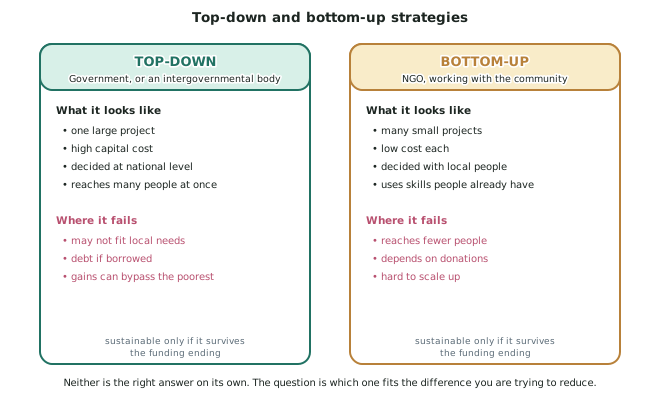
Top-down and bottom-up
- A top-down strategy is decided nationally or internationally and delivered to people. Its strength is scale: one decision can reach millions.
- A bottom-up strategy is decided with the people it affects and delivered by them. Its strength is fit: it addresses what the community said the problem was.
- Each fails in the way the other succeeds. Top-down projects can miss local conditions and leave debt; bottom-up projects reach few people and are hard to scale.
- Neither is correct in general. The question is which fits the specific difference being reduced — a national vaccination programme cannot be run village by village, and a village water supply does not need a ministry.
- The best-designed strategies use both: national funding and standards, local decisions on siting, staffing and maintenance.
Judging the effects of a strategy
- Ask five questions, in this order. They convert a description into an evaluation, which is what the stem asks for.
- What changed, and by how much? Name the indicator and give the before and after figures.
- Who benefited? A national average can rise while the poorest fifth is unaffected, so say which group gained.
- Will it survive the funding ending? A strategy that stops when the money stops has reduced no difference permanently.
- What did it cost, including what was given up? A loan-funded project carries repayments; a tied project spends part of its value overseas.
- Does it break a loop, or top up a shortfall? Because development differences reproduce themselves, a one-off transfer is usually absorbed. A strategy that changes the mechanism keeps working after it ends.
- Sustainability is the word the paper rewards, and it is question 3: meeting present needs without preventing future generations from meeting theirs.
- State an unintended effect if you know one — a road that improves access also brings competition for local producers. Naming one shows evaluation rather than advocacy.
Worked Example
Worked example
With reference to TWO named strategies, explain their effects on reducing differences in development. Support your answer with case study evidence.
Answer:
Strategy 1 — a government rural water supply programme (top-down).
What it is. The government of invented Aluvia, funded partly by a multilateral loan, installed piped supply from protected sources to 40 villages in the eastern districts over six years.
The effect, with figures. Household piped supply in those villages rose from 9 per cent to 78 per cent. Infant mortality fell from 71 to 44 per 1,000 over the same period. Girls' school attendance in the same villages rose by about 11 percentage points, because the water walk had been theirs.
Judging it. It reached many people quickly — the top-down strength. But it was loan-funded, covered 40 villages out of several hundred, and depends on maintenance funding continuing (question 3). It breaks a loop — illness lowers schooling lowers income lowers health spending — which is why its effects continue after the pipes are laid.
Strategy 2 — an NGO microfinance and hand-pump maintenance scheme (bottom-up).
What it is. An NGO trains two people per village to repair hand pumps with locally available tools, and provides small loans, typically US$60 to US$300, mostly to women, for tools, stock or transport.
The effect, with figures. Across 120 villages, the share of pumps working at any time rose from 54 per cent to 91 per cent. Median household income among borrowers rose about 18 per cent in three years, and repayment was around 94 per cent.
Judging it. It fits local conditions and survives the funding ending, because the skills and tools stay in the village — the strongest answer to question 3. Its limits are equally clear: US$300 does not build a clinic, it reaches households rather than regions, and expansion depends on continuing donations.
Comparing the two, which is what lifts the answer.
They reduce different differences: the water programme a health difference between districts, the microfinance scheme an income difference between households in a village. Neither could do the other's job — an NGO cannot lay a district trunk main, and a ministry cannot decide where one village's pump should sit.
(All places, programmes and figures invented for this page.)