Elasticity of supply
The concept
- Price elasticity of supply (PES) measures how responsive quantity supplied is to a change in price.
PES = % change in quantity supplied ÷ % change in price
- PES is normally positive, because price and quantity supplied move in the same direction.
| PES value | Name | Meaning |
|---|---|---|
| 0 | Perfectly inelastic | Quantity supplied cannot change at all |
| Between 0 and 1 | Inelastic | Quantity supplied changes proportionately less than price |
| 1 | Unitary | Same proportion |
| Above 1 | Elastic | Quantity supplied changes proportionately more than price |
| Infinite | Perfectly elastic | Any quantity can be supplied at that price |
What determines it
Supply is more elastic when the producer can change output quickly:
- Spare capacity — idle machinery and available workers mean output can rise immediately.
- Goods can be stored — stock can be released from a warehouse the moment the price rises.
- Production takes little time — manufacturing a simple item, or providing a service.
- Inputs are easy to obtain — labour and materials are readily available.
- The time period is long.
Supply is more inelastic when the producer cannot:
- Production takes a long time — crops have a growing season, trees take decades, buildings take years.
- The good is perishable — it cannot be stockpiled.
- Capacity is already at its limit — a factory running three shifts cannot add a fourth.
- Specialised inputs are scarce — skilled staff or specialised equipment take time to obtain.
- The time period is short.
Why time is the dominant factor
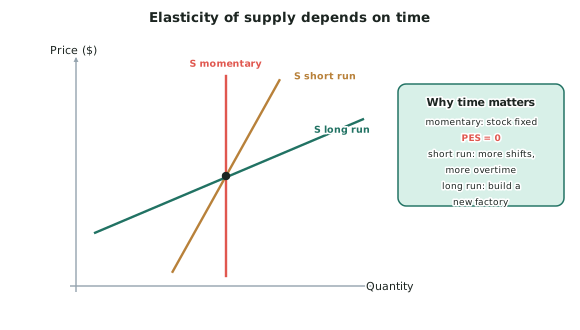
- The momentary period — supply is perfectly inelastic (PES = 0), drawn vertical. Whatever stock exists is all there is; nothing can be produced in response to a price change.
- The short run — supply is inelastic but not zero. Some inputs are fixed, but the producer can add overtime, extra shifts or casual staff. Drawn steep.
- The long run — supply is elastic. All inputs are variable, so a producer can build a new factory, plant a new orchard or enter the industry. Drawn shallow.
Why it matters
- PES decides how much of a demand increase shows up as a higher price and how much as more output.
- With inelastic supply, an increase in demand mostly raises the price.
- With elastic supply, the same increase mostly raises the quantity.
- This is why a sudden surge in demand for housing produces a price spike rather than more houses — the supply of housing is highly inelastic in the short run because construction takes years.
- It also decides how much of a tax producers can pass on. The side that is less elastic bears more of it.
Gathering data for this concept
- An interview with a local producer: "If the price rose by 20% tomorrow, how much more could you supply this week? This month? This year?" That single question produces a momentary, short-run and long-run PES.
- Published data on production volumes and prices over time for a commodity.
- Present it as a supply schedule at different time horizons, calculate PES for each, and plot all three supply curves on one set of axes.
Worked ExampleInterviewing a producer about supply elasticity
An illustrative interview with a market gardener asked: "If the wholesale price of your main crop rose by 25%, how much more could you supply?"
The gardener's answers:
| Time period | Response |
|---|---|
| This week | "Nothing extra — what's picked is picked. Maybe 2% more if I pick harder." |
| This season | "About 8% more. I could plant the spare block and put on casual pickers." |
| In three years | "Around 40% more. I'd lease the neighbouring land and put in a second glasshouse." |
Calculate PES for each period, explain the pattern, and explain what it means for prices when demand rises suddenly.
Step 1 — Calculate PES for the momentary period
% change in Qs = 2% % change in price = 25%
PES = 2 ÷ 25 = 0.08
This is very close to zero, so supply is almost perfectly inelastic.
Step 2 — Calculate PES for the short run
% change in Qs = 8% % change in price = 25%
PES = 8 ÷ 25 = 0.32
Below 1, so supply is inelastic, but noticeably more responsive than in the momentary period.
Step 3 — Calculate PES for the long run
% change in Qs = 40% % change in price = 25%
PES = 40 ÷ 25 = 1.6
Above 1, so supply is now elastic.
Step 4 — Explain the pattern
| Period | PES | Interpretation |
|---|---|---|
| This week | 0.08 | Almost perfectly inelastic |
| This season | 0.32 | Inelastic |
| Three years | 1.6 | Elastic |
PES rises as the time period lengthens, and the reason is which inputs the gardener can vary.
- This week every input is fixed. The crop in the ground is all there is, and no price rise can create more of it. Supply is effectively vertical.
- This season some inputs become variable — the gardener can plant the spare block and hire casual pickers — but the land and the glasshouse are still fixed. Supply is steep.
- In three years all inputs are variable. Land can be leased, a second glasshouse built, and new plantings brought to maturity. Supply is shallow.
Step 5 — Plot the three curves
All three supply curves pass through the same starting point (the current price and quantity) and fan out from it:
- Momentary: near-vertical
- Short run: steep
- Long run: shallow
Step 6 — Explain what this means when demand rises suddenly
Suppose a health story causes a sudden surge in demand. Demand shifts right along whichever supply curve applies.
- Immediately, supply is near-vertical. The demand increase produces almost no extra quantity and a very large price rise. Consumers face a price spike and the gardener earns a windfall.
- Within a season, the gardener plants the spare block. Quantity rises somewhat and the price falls back partway.
- Within three years, the gardener and competitors expand capacity substantially. Quantity rises a great deal and the price falls back close to where it started.
The general implication. When supply is inelastic, a demand shock shows up as a price change. When supply is elastic, the same shock shows up as a quantity change.
This is precisely why housing prices spike after a surge in demand: houses take years to build, so short-run supply is highly inelastic and the whole adjustment falls on price. It is also why a price spike in a market with elastic long-run supply is usually temporary — the high price is itself the signal that brings the extra capacity into being.