Monopolistic competition and oligopoly
Which structures belong here
- The standard says "market structures (excluding perfect competition and monopoly)".
- That leaves exactly two: monopolistic competition and oligopoly.
- Perfect competition and monopoly belong to AS91400 and are not assessed in this standard.
Monopolistic competition
Characteristics
- Many small firms, none of them large enough to dominate.
- A differentiated product — each firm's version is slightly different in branding, quality, location or service. This is the defining feature.
- No significant barriers to entry or exit.
- Firms have some price-setting power, but not much, because close substitutes exist.
New Zealand examples: cafés, hairdressers, takeaway outlets, plumbers, clothing retailers, gyms.
What differentiation does
- Because each firm's product is slightly different, its own demand curve slopes down rather than being horizontal — it can raise its price a little without losing every customer.
- But because there are many close substitutes, that demand curve is relatively elastic. Raise the price too far and customers go next door.
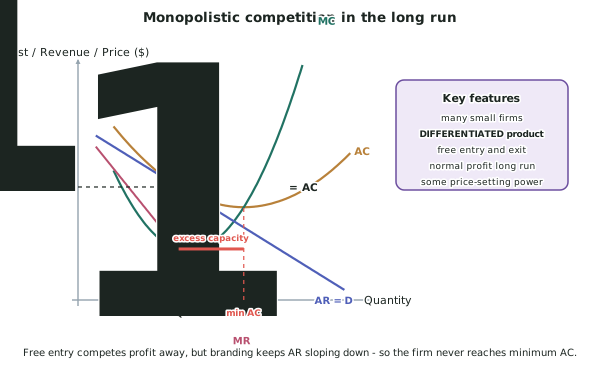
The long run
- In the short run a firm can make supernormal profit if its product is distinctive enough.
- Because there are no significant barriers to entry, that profit attracts new firms offering similar products. Each existing firm's demand curve shifts left as customers are split more ways.
- Entry continues until firms make normal profit only, where the AR curve is tangent to the AC curve.
- At that point output is to the left of minimum AC, so the firm has excess capacity — it could produce more cheaply per unit but has no customers for that extra output.
Non-price competition
- Because price competition is limited by close substitutes, firms compete on branding, advertising, quality, location, opening hours and loyalty schemes.
Oligopoly
Characteristics
- A few large firms dominate the market.
- High barriers to entry — large capital requirements, brand loyalty, control of distribution.
- Products may be identical (petrol, cement) or differentiated (supermarkets, banks, telecommunications).
- Interdependence — each firm's best decision depends on what its rivals do. This is the defining feature.
New Zealand examples: supermarkets, banks, fuel retailers, telecommunications, electricity retailers, building supplies.
Why prices are sticky
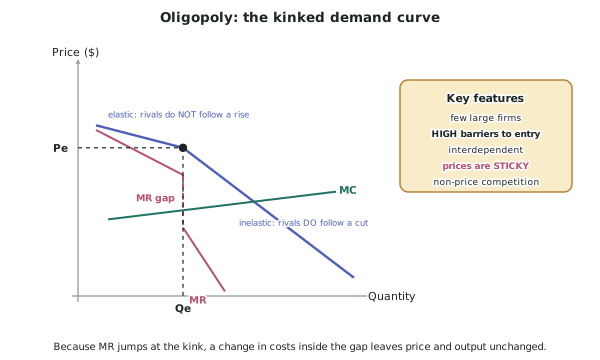
- The kinked demand curve model explains why oligopoly prices change so rarely.
- Above the current price, demand is elastic — if one firm raises its price, rivals will not follow, so it loses a large share of its customers to them.
- Below the current price, demand is inelastic — if one firm cuts its price, rivals will follow to protect their share, so it gains very few extra customers.
- Because each demand segment has its own MR, the MR curve jumps vertically at the kink. Costs can move up or down within that gap without changing the profit maximising output.
- Result: prices are sticky. Neither raising nor cutting is attractive, so firms leave the price where it is and compete in other ways.
Non-price competition and collusion
- Oligopolists compete through advertising, loyalty programmes, product range, opening hours and store networks.
- Because there are few of them, there is always a temptation to collude — agreeing on prices or dividing the market. In New Zealand, price fixing and cartel conduct are illegal under the Commerce Act 1986, enforced by the Commerce Commission.
Comparing the two
| Monopolistic competition | Oligopoly | |
|---|---|---|
| Number of firms | Many | Few |
| Barriers to entry | Low or none | High |
| Product | Differentiated | Identical or differentiated |
| Interdependence | Little — too many rivals to track | Central — every decision depends on rivals |
| Price setting | Some power, limited by substitutes | Significant power, but sticky prices |
| Long run profit | Normal — entry competes it away | Supernormal can persist — barriers block entry |
| Main competitive weapon | Differentiation and branding | Non-price competition, sometimes collusion |
Worked ExampleIdentifying a market structure from interview evidence
An illustrative interview with the owner of a suburban café produced the following:
- "There are about fifteen other cafés within a ten-minute drive."
- "Ours is known for the roast we use and the courtyard — people come for that specifically."
- "Anyone with $80,000 and a lease could open one tomorrow. Two have opened near us in the last three years."
- "If I put my flat white up 50 cents I'd lose maybe a fifth of my regulars to the place down the road. But I wouldn't lose all of them."
- "Margins are thin. After rent and wages there's not much left."
Identify the market structure, justify it against the characteristics, and explain what the last two statements show.
Step 1 — Test each characteristic against the evidence
| Characteristic | Evidence | Verdict |
|---|---|---|
| Number of firms | "About fifteen other cafés within a ten-minute drive" | Many |
| Product | "Known for the roast we use and the courtyard" | Differentiated |
| Barriers to entry | "$80,000 and a lease... two have opened in three years" | Low |
| Price-setting power | "I'd lose maybe a fifth... but not all of them" | Some, but limited |
| Long run profit | "Margins are thin, not much left" | Normal profit |
Step 2 — Rule out the alternatives
Not perfect competition, because the product is differentiated — customers come specifically for the roast and the courtyard. A perfectly competitive firm sells an identical product and has no price-setting power at all.
Not monopoly, because there are fifteen close substitutes within a short drive and no barriers to entry.
Not oligopoly, because there are many firms rather than a few, entry barriers are low, and the owner does not have to track what two or three named rivals are doing.
Step 3 — Identify the structure
This is monopolistic competition. Every characteristic matches: many small firms, a differentiated product, low barriers to entry, limited price-setting power.
Step 4 — Interpret the pricing statement
"If I put my flat white up 50 cents I'd lose maybe a fifth of my regulars, but I wouldn't lose all of them."
This single sentence describes the shape of the firm's demand curve and it is the key evidence.
- "I wouldn't lose all of them" means the demand curve slopes down rather than being horizontal. The owner has some price-setting power, which comes from product differentiation — the roast and the courtyard give a group of customers a reason to stay.
- "I'd lose maybe a fifth" means demand is relatively elastic. Losing 20% of customers for a 50 cent rise on, say, a $5.50 coffee is roughly a 9% price rise producing a 20% quantity fall, giving PED ≈ 2.2. That elasticity comes from the fifteen close substitutes within a short drive.
Differentiation gives the slope; close substitutes make it shallow. Those are exactly the two forces that define monopolistic competition.
Step 5 — Interpret the margins statement
"Margins are thin. After rent and wages there's not much left."
This is the long-run outcome of monopolistic competition, and it follows directly from the low barriers to entry the owner described.
- When cafés in the area were making supernormal profit, that profit was visible and entry was cheap — "$80,000 and a lease".
- New cafés entered — "two have opened near us in the last three years".
- Each new café took a share of the customers, so every existing café's demand curve shifted left.
- Entry continued until the demand curve was tangent to the average cost curve, at which point price = average cost and firms make normal profit only.
Thin margins are not a sign that this café is badly run. They are the predicted equilibrium for any monopolistically competitive market with low barriers to entry, and they would be the same for all fifteen competitors.
Step 6 — The excess capacity implication
Because the AR curve is tangent to AC at a point on the falling section of AC, the café produces less than the output at which its average cost would be lowest. It has excess capacity — empty tables at 10am on a Tuesday.
It could serve more customers at a lower cost per cup, but there are not enough customers to fill it, because they are split fifteen ways. Excess capacity is the price the market pays for variety.