Diminishing returns and supply
The three product measures
- Total product (TP) — the total output produced by a given quantity of a variable input, with other inputs fixed.
- Marginal product (MP) — the extra output from one more unit of the variable input.
MP = change in TP ÷ change in the variable input
- Average product (AP) — output per unit of the variable input.
AP = TP ÷ quantity of the variable input
The law of diminishing returns
- As more units of a variable input are added to a fixed input, the marginal product of each extra unit eventually falls.
- Three parts of that sentence matter and are frequently missed:
- A variable input added to a FIXED input. Diminishing returns is a short run idea. If every input can be increased together, it does not apply.
- Eventually. MP often rises at first, because early workers can specialise and the fixed capital is under-used.
- Marginal product, not total product. TP is usually still rising when diminishing returns set in.
Reading the curves together
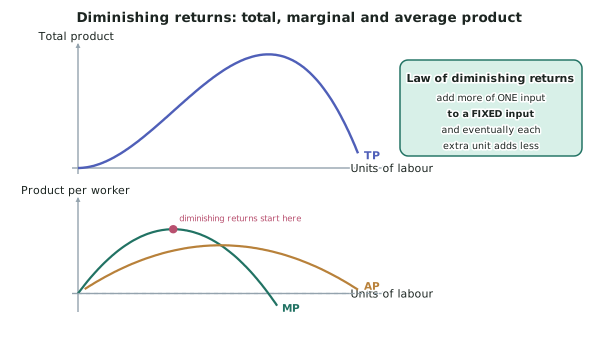
- While MP is rising, TP is rising at an increasing rate — the curve is getting steeper.
- Diminishing returns begins where MP reaches its peak and starts to fall.
- While MP is positive but falling, TP is still rising, but at a decreasing rate.
- TP is at its maximum where MP = 0.
- If MP is negative, TP falls — an extra worker gets in the way.
- MP cuts AP at AP's maximum, for exactly the same arithmetic reason that MC cuts AC at AC's minimum.
Why this explains the supply curve
This is the point of the concept and it must appear in every answer.
- Producing one more unit of output requires more of the variable input.
- Because MP falls, each extra worker or extra unit of input produces less additional output than the one before.
- So more and more input is needed to produce each successive unit of output.
- Since the input costs money, the cost of producing each extra unit — the marginal cost — rises.
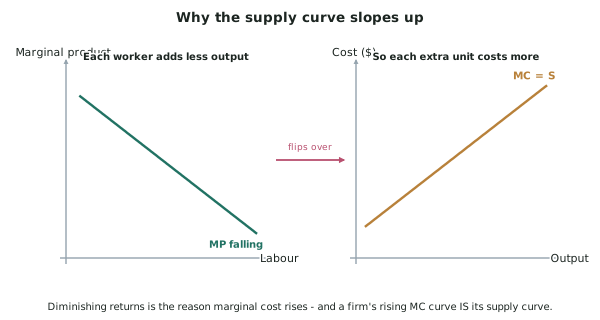
- A producer will only supply an extra unit if the price covers its marginal cost. Because MC rises with output, a higher price is needed to bring forth a greater quantity supplied.
- The supply curve therefore slopes up, and it is the firm's rising marginal cost curve.
Diminishing returns and diminishing marginal utility are different
- Diminishing marginal utility is about a consumer's satisfaction falling as they consume more.
- Diminishing returns is about a producer's extra output falling as they add more of one input.
- They are the same shape and the same arithmetic, which is why they are taught together — but they explain opposite sides of the market.
Gathering data for this concept
- A class simulation: give teams a fixed workspace and a fixed set of tools, add one worker at a time, and record how many items each successive team assembles in a fixed period.
- An interview with a local producer about how output changes as they add staff to a fixed site.
- Present it as a table of TP, MP and AP, plot all three, and identify where diminishing returns begins.
Worked ExampleRunning a production simulation
An illustrative class simulation gave each team one workbench and one set of tools, then added assemblers one at a time. Each team had ten minutes to assemble as many units as possible.
| Assemblers | Total units assembled |
|---|---|
| 1 | 6 |
| 2 | 16 |
| 3 | 30 |
| 4 | 40 |
| 5 | 46 |
| 6 | 48 |
| 7 | 47 |
Process this into marginal and average product, identify where diminishing returns begins, and explain what it shows about the supply curve.
Step 1 — Calculate marginal product
Subtract each total from the one before it.
| Assemblers | TP | MP |
|---|---|---|
| 1 | 6 | 6 |
| 2 | 16 | 10 |
| 3 | 30 | 14 |
| 4 | 40 | 10 |
| 5 | 46 | 6 |
| 6 | 48 | 2 |
| 7 | 47 | −1 |
Step 2 — Calculate average product
Divide total product by the number of assemblers.
| Assemblers | TP | AP = TP ÷ L |
|---|---|---|
| 1 | 6 | 6.0 |
| 2 | 16 | 8.0 |
| 3 | 30 | 10.0 |
| 4 | 40 | 10.0 |
| 5 | 46 | 9.2 |
| 6 | 48 | 8.0 |
| 7 | 47 | 6.7 |
Step 3 — Identify where diminishing returns begins
MP rises from 6 to 10 to 14, then falls to 10, 6, 2 and −1.
Marginal product reaches its maximum of 14 at the 3rd assembler.
Diminishing returns therefore begins at the 4th assembler, which is the first one whose marginal product is lower than the one before.
Step 4 — Explain why MP rises first, then falls
Why it rises at first. With only one assembler, the single workbench and set of tools are heavily under-used, and one person must do every step of the job. Adding a second and third allows specialisation — each takes one part of the process and becomes faster at it — so each additional assembler adds more than the one before.
Why it falls after the third. The workbench and tools are fixed. Once three people are using them, a fourth has to wait for tools, has less bench space, and gets in the others' way. Each additional assembler therefore adds less than the one before.
This is the law of diminishing returns: as more units of a variable input (labour) are added to a fixed input (the workbench and tools), the marginal product eventually falls.
Step 5 — Read the other turning points
- TP is at its maximum of 48 units at the 6th assembler, which is where MP has fallen to 2 and is about to turn negative.
- At the 7th assembler, MP = −1, so TP falls to 47 — the extra person actively gets in the way.
- MP cuts AP at AP's maximum: AP peaks at 10.0 around the 3rd and 4th assemblers, which is exactly where MP crosses it on the way down.
Step 6 — Convert to marginal cost
Suppose each assembler is paid $20 for the ten minutes.
Marginal cost of a unit = wage of the extra assembler ÷ marginal product
| Assembler | MP | MC per unit |
|---|---|---|
| 3rd | 14 | $20 ÷ 14 = $1.43 |
| 4th | 10 | $20 ÷ 10 = $2.00 |
| 5th | 6 | $20 ÷ 6 = $3.33 |
| 6th | 2 | $20 ÷ 2 = $10.00 |
Marginal cost rises steeply, and it rises for exactly one reason: marginal product is falling.
Step 7 — Explain the supply curve
A producer will supply an extra unit only if the price at least covers its marginal cost.
- At a price of $1.50, only the units produced up to the 3rd assembler are worth making, so quantity supplied is 30.
- At $3.50, the units from the 5th assembler become worth making, so quantity supplied rises to 46.
- At $10.00, even the 6th assembler's units are worth making, so quantity supplied rises to 48.
A higher price is required to bring forth a greater quantity supplied, so the supply curve slopes upwards. Its shape is the rising marginal cost curve, and marginal cost rises because of diminishing returns.