Free trade agreements, tariffs and protection
Why this page is here
- Tariffs, quotas, subsidies and free trade agreements are not named in the standard's Explanatory Notes. The examinable concepts are the export/import goods, services and markets, and the current account balance.
- But they appear in the exam every year or two, as the context for the three models — the NZ–UK FTA in 2022, protecting local growers in 2023, a tariff on dairy in 2024, CPTPP in 2025.
- So learn them as things that move a curve or change a trade price, not as a topic in their own right.
Free trade
- Free trade means goods and services move between countries without artificial barriers — no tariffs, no quotas, no discriminatory rules.
- It lets each country specialise where its opportunity cost is lowest, so total output and consumption are higher in both countries.
A free trade agreement
- A free trade agreement (FTA) is a treaty between two or more countries that reduces or removes barriers to trade between them.
- New Zealand's agreements are negotiated by the Ministry of Foreign Affairs and Trade (MFAT) and include the CPTPP, the NZ–UK FTA and the NZ–EU FTA.
- What an FTA does on the models:
- Removing a tariff means New Zealand goods reach the partner market without the tariff added to their price, so effective demand for New Zealand product rises.
- On the two-country model, that raises the trade price Pt and increases New Zealand's exports.
- Higher export receipts raise demand for NZ$, so the NZ$ tends to appreciate.
Why "complementary" economies gain most from an FTA: if the partner buys what New Zealand is good at producing and sells what New Zealand is bad at producing, removing barriers unlocks a lot of trade. If the partner produces the same things New Zealand does, there is much less to gain.
Protection: the methods
Tariff
- A tax on imports, which raises the price of the imported good in the domestic market.
- On the model, the world price line effectively moves up by the amount of the tariff.
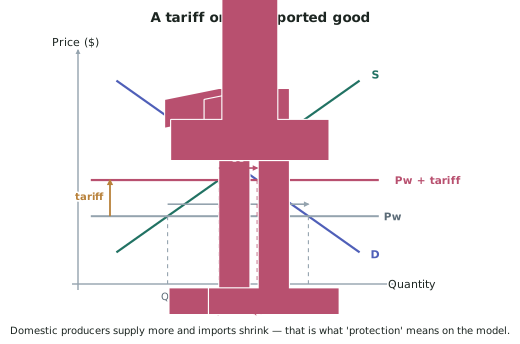
- Effects: domestic production rises (Qs to Qs1), domestic consumption falls (Qd to Qd1), so imports shrink (M to M1). The government collects tariff revenue.
- Winners: domestic producers, the government. Losers: domestic consumers, who pay more and consume less.
Quota
- A limit on the quantity of a good that may be imported.
- Restricts supply directly, raising the domestic price. Unlike a tariff, it raises no government revenue.
Subsidy to domestic producers
- A government payment to domestic producers, lowering their costs so they can undercut imports.
- The cost falls on taxpayers rather than on consumers at the till.
Regulations and standards
- Rules on labelling, safety, biosecurity or content that imported goods must meet. Legitimate ones protect health and biosecurity; others function as disguised protection.
Why a government might protect
- Protect domestic jobs in an industry facing cheaper imports.
- Protect an infant industry until it is large enough to compete.
- Protect strategically important production, such as food or fuel security.
- Prevent dumping — foreign producers selling below cost to drive out local competitors.
Why New Zealand generally does not
- New Zealand is a small, export-dependent economy. Its prosperity depends on other countries not protecting their markets against New Zealand exports — so it has little credibility demanding free access while restricting its own.
- Protecting an industry raises prices for New Zealand consumers, and the loss to consumers usually exceeds the gain to producers.
- Protection misallocates resources: it keeps land, labour and capital in industries where New Zealand's opportunity cost is high, instead of releasing them to dairy, horticulture, tourism and services where returns are far greater.
- Other countries may retaliate, which would harm New Zealand exporters far more than protection could ever help an import-competing industry.
Worked ExampleA tariff on a New Zealand export
A country imposes a tariff on imported dairy products, including New Zealand dairy.
(a) Explain how the tariff protects that country's own dairy producers. (b) Explain the impact on New Zealand dairy exporters.
Step 1 — (a) What the tariff does in the importing country's market
A tariff is a tax on imports, paid when the imported good enters the country. It is added to the price the imported good sells for.
On the model of that country's dairy market, the effective world price line rises by the amount of the tariff, from Pw to Pw + tariff.
Step 2 — Read the effects in that market
At the higher price:
- Domestic producers move up their supply curve — production is now profitable at a higher price, so quantity supplied rises from Qs to Qs1.
- Domestic consumers move up their demand curve — the good is dearer, so quantity demanded falls from Qd to Qd1.
- Imports are the gap , and both movements narrow it. Imports fall from M to M1.
How the protection works: domestic producers sell more, at a higher price, and face less competition from imports. The government also collects tariff revenue on the imports that still arrive.
Who pays for it: that country's own consumers, through the higher price and the reduced quantity they consume.
Step 3 — (b) The impact on New Zealand dairy exporters
New Zealand exporters face a market where their product now sells at a higher price to the final buyer — not because their costs rose, but because a tax has been added.
- Buyers in that market switch toward domestically produced dairy, which is now relatively cheaper.
- New Zealand's export volume to that market falls.
- Export receipts fall, because the quantity exported has dropped. New Zealand exporters do not receive the tariff — it goes to the foreign government.
To keep any volume at all, New Zealand exporters may have to cut the price they charge, absorbing part of the tariff themselves. Then they lose on both price and quantity.
Step 4 — The wider consequence for New Zealand
Falling export receipts reduce , so:
- Net exports fall → AD shifts left → real GDP and employment fall.
- The balance on goods and services worsens.
- Reduced overseas demand for NZ$ shifts demand for NZ$ left, so the NZ$ tends to depreciate.