How the exchange rate is determined
Question Three, every single year
- The standard names a third model: supply and demand for the $NZ, to show how an exchange rate is determined.
- Question Three of AS91223 has been the exchange rate in every paper from 2022 to 2025. Prepare it properly.
What an exchange rate is
- The exchange rate is the price of one currency in terms of another — how much foreign currency one New Zealand dollar buys.
- New Zealand has a floating exchange rate: it is set by supply and demand in the foreign exchange market, not by the government or the RBNZ.
- Appreciation — the NZ$ rises in value: one NZ$ buys more foreign currency.
- Depreciation — the NZ$ falls in value: one NZ$ buys less foreign currency.
The model
- Vertical axis: the exchange rate (Er), expressed in the foreign currency — for example US$ per NZ$.
- Horizontal axis: the quantity of NZ$ traded.
- Demand for NZ$ (D NZ$) slopes down.
- Supply of NZ$ (S NZ$) slopes up.
- Equilibrium gives the exchange rate Er and the quantity Q.
Who DEMANDS New Zealand dollars
Anyone who needs NZ$ to pay a New Zealander.
- Overseas buyers of New Zealand exports — a Japanese importer buying New Zealand butter must obtain NZ$ to pay for it.
- Overseas tourists visiting New Zealand — they must convert their currency into NZ$ to spend here.
- Overseas investors buying New Zealand assets — shares, property, government bonds.
- Overseas savers attracted by New Zealand interest rates — if New Zealand rates rise relative to other countries', foreign funds flow in seeking a better return, which requires buying NZ$.
Who SUPPLIES New Zealand dollars
Anyone who needs to sell NZ$ to obtain foreign currency.
- New Zealand importers — they must sell NZ$ to buy the foreign currency their suppliers require.
- New Zealanders travelling overseas — they sell NZ$ to buy the currency of the country they are visiting.
- New Zealanders investing overseas — buying foreign shares or property requires foreign currency.
What shifts each curve
| Event | Curve | Direction | Effect on Er |
|---|---|---|---|
| Exports rise | D NZ$ | Right | Appreciates |
| Exports fall | D NZ$ | Left | Depreciates |
| More overseas tourists | D NZ$ | Right | Appreciates |
| Overseas investment into NZ rises | D NZ$ | Right | Appreciates |
| NZ interest rates rise relative to overseas | D NZ$ | Right | Appreciates |
| Imports rise | S NZ$ | Right | Depreciates |
| More New Zealanders travelling overseas | S NZ$ | Right | Depreciates |
| New Zealanders investing overseas | S NZ$ | Right | Depreciates |
The two chains you must be able to write
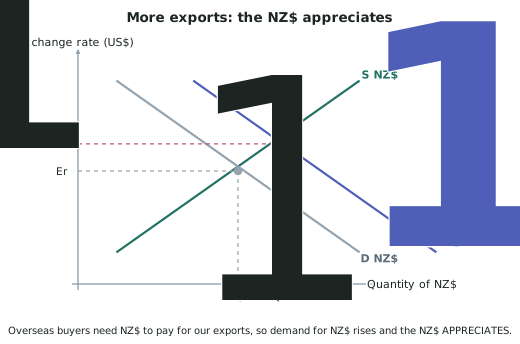
Exports rise → appreciation
- Overseas buyers want more New Zealand goods.
- They need NZ$ to pay for them.
- Demand for NZ$ shifts right, from D to D1.
- The exchange rate rises from Er to Er1 — the NZ$ appreciates.
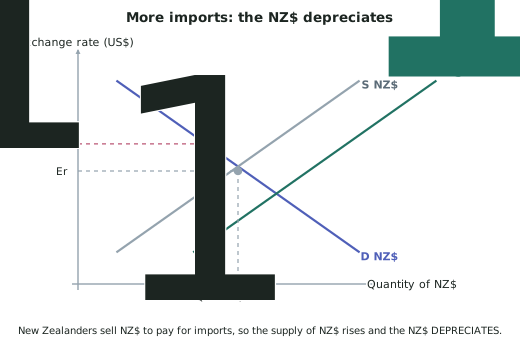
Imports rise → depreciation
- New Zealanders want more overseas goods.
- They must sell NZ$ to buy foreign currency.
- Supply of NZ$ shifts right, from S to S1.
- The exchange rate falls from Er to Er1 — the NZ$ depreciates.
Worked ExampleAn export surge and an import surge
(a) New Zealand signs an agreement that leads to a large increase in exports to the United States. Show and explain the effect on the NZ$/US$ exchange rate.
(b) In the same period, New Zealand households buy substantially more imported electronics from the United States. Show and explain the effect.
Step 1 — (a) Which curve, and why
American buyers want more New Zealand goods. To pay New Zealand exporters, they must obtain New Zealand dollars — New Zealand firms want to be paid in NZ$, not US$.
Wanting to get NZ$ is demand for NZ$.
Demand for NZ$ shifts right, from D NZ$ to D1 NZ$. The supply curve is unchanged.
Step 2 — Read the new equilibrium
D1 cuts the unchanged supply curve higher up and further right:
- The exchange rate rises from Er to Er1
- The quantity of NZ$ traded rises from Q to Q1
A higher exchange rate means one NZ$ now buys more US$. The NZ$ has appreciated.
Step 3 — (b) Which curve, and why
New Zealand households want more American electronics. To pay American suppliers, they must obtain US dollars, and to do that they must sell New Zealand dollars on the foreign exchange market.
Wanting to get rid of NZ$ is supply of NZ$.
Supply of NZ$ shifts right, from S NZ$ to S1 NZ$. The demand curve is unchanged.
Step 4 — Read the new equilibrium
S1 cuts the unchanged demand curve lower down and further right:
- The exchange rate falls from Er to Er1
- The quantity of NZ$ traded rises from Q to Q1
One NZ$ now buys fewer US$. The NZ$ has depreciated.