Appreciation and depreciation: who gains and who loses
The Excellence part of Question Three
- Question Three always ends with a compare and contrast part: two groups, one exchange rate movement.
- Recent pairings: New Zealand tourists going overseas vs New Zealand importers (2025); an importing business vs a tour operator (2024); a tour guide business buying an imported vehicle (2022).
- Learn the mechanism, not a list, because the pairing changes every year.
The one rule everything follows
- An appreciation makes foreign things cheaper for New Zealanders, and New Zealand things dearer for foreigners.
- A depreciation does the reverse.
Every winner and loser follows from that single sentence.
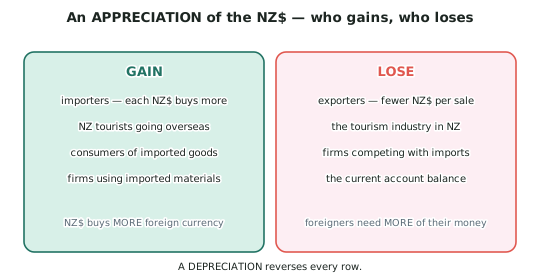
An APPRECIATION — the NZ$ rises
| Group | Effect | Why |
|---|---|---|
| Importers | Gain | Each NZ$ buys more foreign currency, so imported goods cost fewer NZ$ |
| New Zealanders travelling overseas | Gain | Their NZ$ buys more foreign currency, so the trip is cheaper |
| Consumers of imported goods | Gain | Cars, electronics, clothing and fuel become cheaper |
| Firms using imported inputs | Gain | Lower costs of production, so AS shifts right |
| Exporters | Lose | Their goods cost foreign buyers more, so volumes fall; and each foreign-currency sale converts into fewer NZ$ |
| The New Zealand tourism industry | Lose | New Zealand becomes a more expensive destination, so visitor numbers fall |
| Import-competing firms | Lose | Cheaper imports undercut them in the domestic market |
| The balance on goods and services | Worsens | X falls, M rises |
A DEPRECIATION — the NZ$ falls
- Every row above reverses.
- Exporters and the tourism industry gain; importers, overseas travellers and consumers of imports lose.
- The balance on goods and services improves.
- But: a depreciation raises the NZ$ cost of imported fuel, machinery and materials, shifting AS left and causing cost-push inflation.
Doing the arithmetic
- Exchange rate NZ$1 = US$0.60. A US$300 item costs:
- The NZ$ appreciates to NZ$1 = US$0.75. The same item now costs:
- The importer saves NZ$100 on an unchanged US price. Nothing about the product changed — only the exchange rate.
- Going the other way: a New Zealand exporter selling for US$300 receives NZ$500 at 0.60 but only NZ$400 at 0.75. The same sale earns less.
The comparison structure that gets Excellence
Any two groups can be compared with the same four moves:
- Say which direction the exchange rate moved and what that means in one sentence.
- Group A — gain or lose, and the mechanism: what do they buy or sell, and in which currency?
- Group B — the same, in the same detail.
- Compare and contrast — usually one gains and one loses from the same movement, because one is buying foreign currency and the other is earning it.
Worked ExampleComparing two affected groups
The New Zealand dollar depreciates significantly against the US dollar.
Compare and contrast the impact of this on: (i) New Zealand tourists visiting the United States (ii) New Zealand businesses importing consumer products from the United States.
Step 1 — State what a depreciation means
A depreciation means one NZ$ now buys fewer US$ than before. Anything priced in US dollars therefore costs more New Zealand dollars.
Step 2 — Group (i): New Zealand tourists visiting the USA
Their spending — flights, hotels, meals, attractions — is priced in US dollars, and they must sell NZ$ to buy US$ to pay for it.
After the depreciation, each NZ$ buys fewer US$, so the same US-dollar holiday costs more New Zealand dollars.
If the rate falls from NZ$1 = US$0.65 to NZ$1 = US$0.55, a US$4,000 trip rises from
— over NZ$1,100 more for an identical holiday.
They lose. Some will shorten the trip, spend less while there, or holiday domestically instead.
Step 3 — Group (ii): New Zealand importers of US consumer products
Their suppliers invoice in US dollars, and they must sell NZ$ to buy US$ to pay them.
After the depreciation, each shipment costs more New Zealand dollars. Their costs rise even though the US price and the product are unchanged.
They face a choice, and both options hurt:
- Pass the cost on — raise New Zealand retail prices, and sell fewer units as customers buy less or switch to alternatives.
- Absorb the cost — hold prices and accept a smaller profit margin.
They lose.
Step 4 — Compare and contrast
The similarity — and the reason for it. Both groups lose, and they lose for exactly the same reason: both are buyers of US dollars. Both must give up more NZ$ to obtain each US$, so anything priced in US dollars has become dearer for both. Their position is identical in mechanism.
The contrast — what each can do about it.
The tourist is making a discretionary, one-off purchase. They can postpone the trip until the rate recovers, shorten it, spend less while overseas, or choose a different destination whose currency has not moved against the NZ$. The cost is real but avoidable, and it falls on them alone.
The importer is running a continuing business built around US suppliers. It cannot simply stop importing without losing its customers and its market position, and it may be locked into supply contracts. Switching to a supplier in another country takes time, and if the NZ$ has depreciated against most currencies there may be nowhere cheaper to go. Its loss is recurring, and it is passed on — to New Zealand consumers as higher prices, and potentially to its staff if it must cut costs.
The wider difference. The tourist's loss stops with the tourist. The importer's loss becomes imported inflation: higher New Zealand dollar costs for imported consumer goods feed directly into the CPI, and higher costs for imported inputs shift AS left, raising the price level for everyone.
The judgement. The importer is more seriously affected, because the loss is ongoing, harder to avoid, and transmitted to third parties, whereas the tourist faces a single avoidable cost they can manage by changing their plans.