Export receipts and the balance on goods and services
Export receipts and import payments
- Export receipts are the total money New Zealand earns from selling goods and services overseas.
- Import payments are the total money New Zealand spends buying goods and services from overseas.
- On the price taker and two-country models, export receipts are the rectangle whose height is the price and whose width is the export gap.
Why both dimensions matter
- Export receipts can change because the price changed, because the quantity changed, or both.
- When both move the same way, the answer is unambiguous:
- World price rises → Qs up, Qd down → quantity up and price up → receipts rise.
- World price falls → Qs down, Qd up → quantity down and price down → receipts fall.
- When they move opposite ways, you must weigh them:
- New Zealand supply falls and this pushes the trade price up → price up, quantity down. Receipts rise only if the price effect is larger.
The balance on goods and services
- This is the concept the standard names, and it is part of the current account.
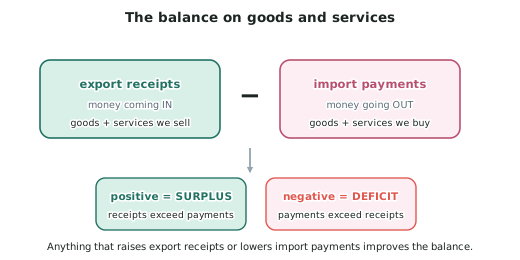
- Surplus — export receipts exceed import payments. New Zealand earns more from the world than it pays out.
- Deficit — import payments exceed export receipts. New Zealand pays out more than it earns, and the gap must be financed by borrowing from overseas or selling assets to overseas owners.
New Zealand has typically run a deficit on the current account, because it imports capital goods and fuel while its exports are concentrated in commodities.
What improves and what worsens the balance
| Event | Effect on the balance |
|---|---|
| World price of an export good rises | Export receipts rise → improves |
| World price of an export good falls | Export receipts fall → worsens |
| Better harvest, more exported at unchanged price | Export receipts rise → improves |
| Strong growth in trading partners | Export volumes rise → improves |
| Strong growth in New Zealand | Households buy more imports → worsens |
| NZ$ depreciates | Exports cheaper overseas, imports dearer here → improves |
| NZ$ appreciates | Exports dearer overseas, imports cheaper here → worsens |
The link back to aggregate demand
- Net exports is one of the four components of aggregate demand:
- So anything that improves the balance on goods and services also shifts AD right, raising real GDP and employment.
- Anything that worsens it shifts AD left.
- This is the sentence that connects AS91223 to AS91222 and AS91224, and using it shows the examiner you can move between standards.
Worked ExampleTwo changes, one balance
In one year:
- The world price of New Zealand's largest export commodity rises by 12%, and the quantity exported rises slightly.
- Strong domestic growth means New Zealand households buy substantially more imported vehicles and electronics.
Explain the effect of each on the balance on goods and services, and on aggregate demand.
Step 1 — The export side
The price has risen 12% and the quantity exported has also risen — on the price taker model, a higher Pw draws out more supply (Qs up) and reduces domestic consumption (Qd down), so the export gap widens.
Both dimensions of the rectangle have grown, so export receipts rise clearly.
On its own this improves the balance on goods and services.
Step 2 — The import side
The quantity of imported vehicles and electronics has risen substantially, because higher New Zealand incomes raise demand for imported consumer durables. Import prices are assumed unchanged.
Import payments rise.
On its own this worsens the balance on goods and services.
Step 3 — The net effect on the balance
Both sides have increased, so the direction of the balance depends on which rose by more.
- If the rise in export receipts is larger, the balance improves — the deficit narrows or a surplus widens.
- If the rise in import payments is larger, the balance worsens.
The 12% price rise applies to New Zealand's largest export commodity, so a 12% gain on a very large base is a substantial dollar amount. Imported vehicles and electronics, while a significant import category, are a smaller share of total import payments. On balance, the improvement is likely to dominate.
Step 4 — The effect on aggregate demand
- Rising pushes AD right.
- Rising pushes AD left, because money spent on imports is spending that does not go to New Zealand producers.
If net exports rise overall, AD shifts right, raising real GDP, employment and the price level.