The molecular ion and molar mass
What a mass spectrometer does
- The sample is ionised, usually by knocking off one electron to form a positive ion.
- The ions are accelerated and then deflected by a magnetic field. Lighter ions deflect more.
- A detector records how many ions arrive at each mass-to-charge ratio (m/z).
- Because almost every ion has a charge of +1, the m/z value is effectively the mass of the ion.
The molecular ion peak
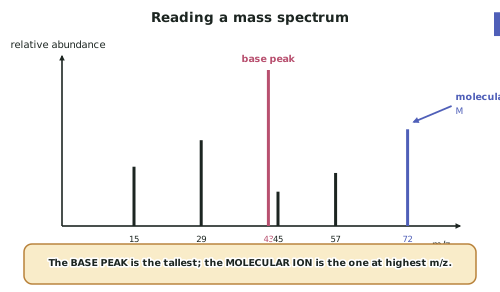
- The molecular ion, M+, is the whole molecule with one electron removed:
-
Its m/z value is the molar mass of the compound.
-
It is normally the peak at the highest m/z, apart from small isotope peaks just to its right.
-
Some molecules fragment so readily that the molecular ion peak is very small or absent. If the highest significant peak looks implausible as a molar mass, consider that possibility.
The base peak
- The base peak is the tallest peak in the spectrum, assigned a relative intensity of 100%.
- It is the most stable fragment ion, not necessarily the molecular ion.
- Do not confuse the two: the base peak tells you about fragmentation, the molecular ion tells you the molar mass.
Reading off the molecular formula
Once you have the molar mass and know a functional group from the IR, you can usually fix the formula.
- Work out how much mass the functional group accounts for, then see what is left for the hydrocarbon part.
- Check the count with the general formulae:
| Family | General formula | Example (M) |
|---|---|---|
| Alkane | butane, 58 | |
| Alkene | butene, 56 | |
| Alcohol | propan-1-ol, 60 | |
| Aldehyde / ketone | propanone, 58 | |
| Carboxylic acid / ester | ethanoic acid, 60 | |
| Primary amine | ethylamine, 45 |
- Useful atomic masses to have memorised: H = 1, C = 12, N = 14, O = 16, Cl = 35, Br = 79.
Degrees of unsaturation
-
Compare the hydrogen count with the saturated alkane of the same carbon number, .
-
Every two hydrogens missing means one double bond or ring.
- C3H6O has 6 H where propane C3H8 has 8 — two missing, so one double bond. With an oxygen present, that is almost certainly a C=O.
- C3H8O has the full complement, so no double bonds — an alcohol or an ether.
-
This is a fast, powerful check. If your IR shows a C=O but the formula has no degrees of unsaturation, one of the two readings is wrong.
Worked ExampleDetermining a molecular formula from the molar mass
A compound gives a molecular ion peak at m/z 74. Its infrared spectrum shows a strong absorption at 1740 cm−1 and no absorption above 3000 cm−1. Determine a possible molecular formula and state the degrees of unsaturation.
Step 1 — Read the molar mass
The molecular ion is at m/z 74, so the molar mass is 74 g mol−1.
Step 2 — Use the IR to identify the functional group
A strong absorption at 1740 cm−1 is a C=O stretch, and its position in the 1735–1750 range points to an ester.
The absence of any absorption above 3000 cm−1 is equally informative: there is no O–H (which would appear as a broad band at 2500–3550) and no N–H. This eliminates alcohols, carboxylic acids, amines and amides.
Step 3 — Account for the mass
An ester contains the group –COO–, which accounts for:
Subtracting from the molar mass leaves:
for the rest of the molecule — the two alkyl groups attached either side.
Thirty mass units of C and H is C2H6, since .
Step 4 — Assemble the formula
Checking: . ✓
This matches the general formula for an ester, , with .
Step 5 — Degrees of unsaturation
The saturated alkane with three carbons is C3H8. Our compound has C3H6 in its hydrocarbon skeleton — two hydrogens fewer, so there is one degree of unsaturation.
That one degree is accounted for by the C=O already identified in the IR. The two readings agree, which is a check that neither is wrong.
Step 6 — Note what is still undetermined
C3H6O2 as an ester has two possible structures: methyl ethanoate, CH3COOCH3, and ethyl methanoate, HCOOCH2CH3. Both have the same formula and the same functional group, so neither the mass spectrum nor the IR can separate them. 13C NMR is needed, and it distinguishes them cleanly.
Answer: C3H6O2, an ester, with one degree of unsaturation accounted for by the C=O group. Two isomers remain possible.