Determining and justifying a full structure
The method, in a fixed order
Follow this every time and the structure falls out.
- 1. Mass spectrum → size and heteroatoms.
- Read the molecular ion for the molar mass.
- Check whether it is odd (one nitrogen) or even (none).
- Check for an M+2 peak: 3 : 1 means chlorine, 1 : 1 means bromine.
- 2. IR → functional group.
- Anything above 3000 cm−1? O–H or N–H, and which.
- Anything near 1700 cm−1? A carbonyl family.
- State the absences — they eliminate whole families.
- 3. Molecular formula.
- Build it from the molar mass and the functional group. Check the degrees of unsaturation match.
- 4. Enumerate the isomers.
- Write out every structure with that formula and that functional group. This is the step that makes justification possible.
- 5. 13C signal count → eliminate.
- Predict the count for each candidate. Cross out those that do not match.
- 6. 13C shifts → confirm.
- Assign every signal in the surviving structure and check each against its range.
- 7. Fragments → cross-check.
- Confirm the mass losses are consistent with the structure you have proposed.
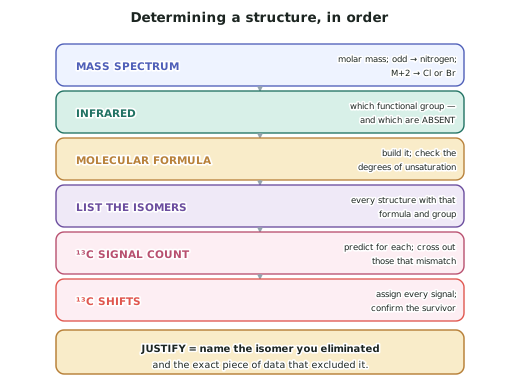
What turns determination into justification
- Enumerate before you conclude. If you never list the alternatives, you cannot show you eliminated them.
- Attach each elimination to a specific datum. "Butanal is eliminated because it would give four 13C signals and the spectrum shows three."
- Use absences as evidence. "No absorption above 3000 cm−1 eliminates carboxylic acids, alcohols, amines and amides."
- Cross-confirm. Where two techniques identify the same feature, say so — that redundancy is what makes an identification secure.
- Check the whole structure back against all the data at the end.
Common places students go wrong
| Error | Fix |
|---|---|
| Reading the number of carbons off the 13C signal count | Signals count environments; get the carbon count from the formula |
| Using the IR carbonyl position to distinguish aldehyde from ester | Use the 13C shift — 190–220 vs 160–185, no overlap |
| Ignoring the M+2 peak | A 1 : 1 or 3 : 1 pair identifies Br or Cl, which the IR cannot |
| Forgetting the nitrogen rule | An odd molar mass means nitrogen is present |
| Concluding without listing isomers | Enumerate first; it is the only way to justify |
| Never mentioning what is absent | Absences eliminate more than presences confirm |
Worked ExampleA complete structure determination
An unknown compound gives the following data. Determine its structure and justify it fully.
- Mass spectrum: molecular ion at m/z 73; fragments at m/z 58 and m/z 30.
- IR: two medium absorptions at 3320 and 3400 cm−1; C–H absorptions just below 3000 cm−1; nothing near 1700 cm−1.
- 13C NMR: two signals, at 26 ppm and 47 ppm.
Step 1 — Mass spectrum: size and heteroatoms
The molecular ion is at m/z 73, so the molar mass is 73 g mol−1.
73 is odd. By the nitrogen rule, the molecule contains an odd number of nitrogen atoms — almost certainly one.
There is no M+2 peak reported, so no chlorine or bromine.
Step 2 — IR: functional group
Two medium absorptions at 3320 and 3400 cm−1 fall in the N–H region (3300–3500). The fact that there are two bands rather than one identifies a primary amine, –NH2, since a primary amine has two N–H bonds and a secondary amine only one.
Nothing near 1700 cm−1 means there is no C=O, which eliminates all six carbonyl families — including amides, the other family containing N–H.
Nothing broad above 3000 apart from the N–H means no O–H, so no alcohol or carboxylic acid.
The compound is a primary amine.
Step 3 — Molecular formula
The NH2 group accounts for , leaving:
for the carbon–hydrogen skeleton. Fifty-seven mass units is C4H9, since .
Check: . ✓
The hydrogen count is odd, exactly as the nitrogen rule predicts.
Degrees of unsaturation: none — C4H11N is the saturated formula for a four-carbon amine (). This agrees with the IR showing no C=O and no C=C.
Step 4 — Enumerate the isomers
Primary amines with formula C4H11N:
- Butan-1-amine, CH3CH2CH2CH2NH2
- Butan-2-amine, CH3CH2CH(NH2)CH3
- 2-methylpropan-1-amine, (CH3)2CHCH2NH2
- 2-methylpropan-2-amine, (CH3)3CNH2
Step 5 — Predict the 13C signal count for each
- Butan-1-amine — four different carbons: 4 signals
- Butan-2-amine — four different carbons: 4 signals
- 2-methylpropan-1-amine — two equivalent methyls, plus a CH and a CH2: 3 signals
- 2-methylpropan-2-amine — three equivalent methyls plus the quaternary carbon: 2 signals
The spectrum shows two signals, so the compound is 2-methylpropan-2-amine, (CH3)3CNH2. The other three are eliminated, each by a specific mismatch in signal count.
Step 6 — Confirm with the chemical shifts
- 26 ppm — the three equivalent CH3 carbons, bonded only to carbon and hydrogen, in the 5–40 ppm alkane range. ✓
- 47 ppm — the quaternary carbon bonded to nitrogen, deshielded into the 25–60 ppm C–N range. ✓
Both assignments fit, and there are exactly two of them, as required.
Step 7 — Cross-check with the fragments
- m/z 58 is a loss of , a CH3 group. A molecule with three equivalent methyls on a central carbon would readily lose one, and this is expected to be a strong peak.
- m/z 30 matches CH2=NH2+ (), a stabilised nitrogen-containing fragment common in amine spectra.
Both fragments are consistent with the proposed structure.
Step 8 — The justified conclusion
Answer: 2-methylpropan-2-amine, (CH3)3CNH2.
Justification, one sentence per technique:
The odd molecular ion at m/z 73 requires one nitrogen atom, and subtracting NH2 leaves C4H9, giving the molecular formula C4H11N. The two N–H absorptions at 3320 and 3400 cm−1 identify a primary amine, and the absence of any absorption near 1700 cm−1 eliminates amides and all other carbonyl families. Of the four primary amines with this formula, only 2-methylpropan-2-amine has enough symmetry to give the observed two 13C signals — butan-1-amine and butan-2-amine would each give four, and 2-methylpropan-1-amine three. The shifts at 26 ppm (three equivalent methyl carbons) and 47 ppm (the quaternary carbon bonded to nitrogen) assign completely, and the loss of 15 to give m/z 58 confirms the methyl groups.