Isotope patterns and fragmentation
Why some spectra have two peaks at the top
- Most elements have more than one isotope. If a heavier isotope is common enough, molecules containing it show up as a separate peak two units to the right of the molecular ion.
- This gives an immediate, unmistakable test for chlorine and bromine.
| Element | Isotopes | Natural ratio | Peak pattern |
|---|---|---|---|
| Chlorine | 35Cl and 37Cl | about 3 : 1 | M and M+2 in a 3 : 1 ratio |
| Bromine | 79Br and 81Br | about 1 : 1 | M and M+2 in a 1 : 1 ratio |
| Carbon | 12C and 13C | about 99 : 1 | small M+1 peak, ~1.1% per carbon |
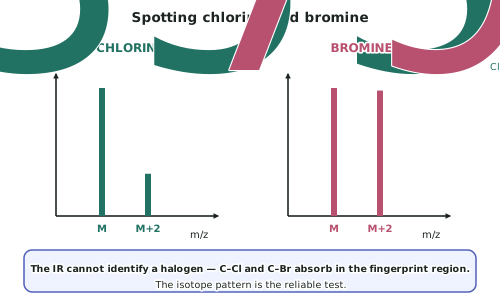
-
A pair of peaks two units apart, roughly equal in height → bromine.
-
A pair of peaks two units apart, the right one about a third as tall → chlorine.
-
Note this identifies which halogen, not just that a halogen is present — which IR cannot do, since C–Cl and C–Br absorptions both sit in the crowded fingerprint region.
The nitrogen rule
- Nitrogen has an even atomic mass (14) but an odd valency (3). This combination makes it detectable from the molar mass alone.
- A molecule of C, H and O only always has an even molar mass.
- An odd molar mass means an odd number of nitrogen atoms — usually one.
| Molar mass | What it suggests |
|---|---|
| Even | no nitrogen, or an even number of nitrogens |
| Odd | one (or three) nitrogen atoms |
- Combined with an IR showing N–H, this pins down an amine or an amide immediately.
Fragmentation
- Inside the spectrometer, the molecular ion breaks apart. The mass lost identifies the piece that broke off.
- Work with the difference between the molecular ion and the fragment peak.
| Mass lost | Fragment lost | Suggests |
|---|---|---|
| 15 | CH3 | a methyl group |
| 17 | OH | a carboxylic acid or alcohol |
| 18 | H2O | an alcohol |
| 28 | CO or C2H4 | a carbonyl or an ethyl chain |
| 29 | CHO or C2H5 | an aldehyde, or an ethyl group |
| 31 | CH2OH or OCH3 | a primary alcohol, or a methyl ester |
| 43 | C3H7 or CH3CO | a propyl group, or an ethanoyl group |
| 45 | COOH or OC2H5 | a carboxylic acid, or an ethyl ester |
-
Fragments themselves also appear as peaks, so both readings are available:
- A peak at m/z 43 is often the CH3CO+ ion, strongly suggesting a methyl ketone or an ethanoate.
- A peak at m/z 29 is often CHO+, suggesting an aldehyde.
-
Where a mass loss is ambiguous — 43 could be C3H7 or CH3CO — the IR resolves it: CH3CO requires a C=O and C3H7 does not.
Using fragments to locate a group
- Fragmentation tells you not just what groups exist but where they are attached.
- Two isomers with the same formula fragment differently, because different bonds break most easily.
- Butan-2-one, CH3COCH2CH3, loses CH3 (15) to give m/z 57, and loses C2H5 (29) to give m/z 43.
- Butanal, CH3CH2CH2CHO, loses CHO (29) to give m/z 43, and loses C3H7 (43) to give m/z 29.
- The pattern of losses is therefore evidence about the skeleton, not only about composition.
Worked ExampleIdentifying a halogen from the isotope pattern
A compound shows peaks at m/z 108 and m/z 110 of approximately equal height, and a strong fragment at m/z 29. Its IR shows C–H absorptions just below 3000 cm−1 and nothing above 3000 cm−1 or near 1700 cm−1. Identify the halogen present and determine the structure.
Step 1 — Interpret the isotope pattern
Two peaks two mass units apart of approximately equal height is the signature of bromine, whose isotopes 79Br and 81Br occur in a roughly 1 : 1 ratio.
(A 3 : 1 ratio would have indicated chlorine instead.)
So the molecular ion is at m/z 108, with the M+2 peak at 110 arising from molecules containing 81Br.
Step 2 — Use the IR to eliminate functional groups
- Nothing above 3000 cm−1 → no O–H and no N–H, so not an alcohol, carboxylic acid, amine or amide.
- Nothing near 1700 cm−1 → no C=O, so not an aldehyde, ketone, ester, amide or acid chloride.
- C–H absorptions just below 3000 cm−1 → a saturated hydrocarbon skeleton.
The only family left from the eleven is a haloalkane — consistent with the bromine already identified.
Step 3 — Work out the rest of the molecule
Subtracting one bromine atom, using the lighter isotope to match the m/z 108 peak:
Twenty-nine mass units of carbon and hydrogen is C2H5, since .
Step 4 — Assemble the formula
Check: . ✓
Step 5 — Confirm with the fragment
The strong fragment at m/z 29 is the C2H5+ ion, produced by loss of the bromine atom (). This is the expected dominant fragmentation for a haloalkane, since the C–Br bond is the weakest bond in the molecule.
Step 6 — Check for isomers
C2H5Br has only one possible structure — with two carbons there is no choice about where the bromine sits. No 13C data is needed to resolve isomers here, though a 13C spectrum would confirm two signals, with the carbon bearing the bromine shifted downfield.
Answer: bromoethane, CH3CH2Br, molecular formula C2H5Br. Bromine is identified by the 1 : 1 M / M+2 pattern, and the absence of any absorption above 3000 cm−1 or near 1700 cm−1 rules out every family except a haloalkane.