Infrared spectroscopy and the key absorptions
How it works
-
Covalent bonds vibrate — they stretch and bend, like springs joining two masses.
-
Each bond vibrates at a characteristic frequency, set by the strength of the bond and the masses of the atoms.
-
When infrared radiation of exactly that frequency passes through, the bond absorbs it and vibrates more.
-
The spectrum plots transmittance against wavenumber in cm−1, so an absorption appears as a downward peak.
-
Because the frequency depends on the bond, each type of bond absorbs in a characteristic region — and that is what makes IR a functional group detector.
The absorption table
| Bond | Wavenumber / cm−1 | Appearance | Found in |
|---|---|---|---|
| O–H (alcohol) | 3230–3550 | broad | alcohols |
| O–H (carboxylic acid) | 2500–3000 | very broad | carboxylic acids |
| N–H | 3300–3500 | medium; two bands for a primary amine | amines, amides |
| C–H | 2850–3000 | sharp, several | all organic compounds |
| C≡N | 2220–2260 | sharp | nitriles |
| C=O | 1670–1750 | strong, sharp | all carbonyl families |
| C=C | 1620–1680 | medium | alkenes |
| C–O | 1000–1300 | strong | alcohols, esters, acids |
| C–Cl, C–Br | below 800 | — | haloalkanes (in the fingerprint region) |
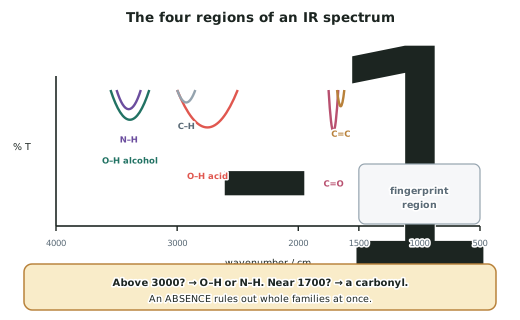
The four regions to look at, in order
Working through in this order gets the functional group in about thirty seconds.
- Above 3000 cm−1 — is there anything there?
- Broad, 3230–3550 → alcohol O–H
- Very broad, 2500–3000 → carboxylic acid O–H
- Medium, 3300–3500, two bands → primary amine or amide N–H
- Nothing → no O–H and no N–H. This is a powerful negative result.
- Around 1700 cm−1 — is there a strong sharp peak?
- Yes → a carbonyl family: aldehyde, ketone, acid, ester, amide or acid chloride.
- No → not a carbonyl compound.
- 1620–1680 cm−1 — a medium peak suggests C=C, an alkene.
- Below 1500 cm−1 — the fingerprint region, dealt with below.
Combining the two key regions
The functional group falls out of a two-by-two comparison:
| C=O present | C=O absent | |
|---|---|---|
| O–H present | carboxylic acid | alcohol |
| N–H present | amide | amine |
| Neither | aldehyde, ketone, ester, acid chloride | alkane, alkene, haloalkane |
- This table alone will get you to the right family in most questions, and it is worth being able to reconstruct it from the reasoning rather than memorising it.
The fingerprint region
-
Below about 1500 cm−1 the spectrum becomes a dense pattern of overlapping absorptions from the whole molecular skeleton.
-
Individual peaks here are hard to assign, but the pattern as a whole is unique to a compound — like a fingerprint.
-
Its use is comparison: matching an unknown's fingerprint region against a reference spectrum confirms identity.
-
Do not try to assign individual peaks in the fingerprint region. Say what it is for, and use the region above 1500 cm−1 for identification.
The value of an absence
-
An absorption that is not there is often more decisive than one that is.
- No peak above 3000 cm−1 rules out alcohols, carboxylic acids, amines and amides — four of the eleven families, in one observation.
- No peak near 1700 cm−1 rules out all six carbonyl families.
-
Together, those two absences leave only alkanes, alkenes and haloalkanes.
-
Always state the absences you are relying on. They are evidence, and Merit answers routinely leave them unmentioned.
Worked ExampleIdentifying a functional group from an IR spectrum
An organic compound with molecular formula C3H6O2 gives an infrared spectrum with a very broad absorption from about 2500 to 3000 cm−1, a strong sharp peak at 1710 cm−1, and a strong peak at 1250 cm−1. Identify the functional group and determine the structure.
Step 1 — Check the region above 3000 cm−1
There is a very broad absorption running from about 2500 to 3000 cm−1.
Two candidates absorb broadly, and the position separates them:
- An alcohol O–H is broad but sits higher, at 3230–3550 cm−1.
- A carboxylic acid O–H is very broad and sits lower, at 2500–3000 cm−1 — often overlapping the C–H absorptions.
This is a carboxylic acid O–H.
Step 2 — Check around 1700 cm−1
There is a strong, sharp peak at 1710 cm−1, which is a C=O stretch. Its position in the 1700–1725 range is consistent with a carboxylic acid.
Step 3 — Combine
O–H present and C=O present together identifies a carboxylic acid, from the two-by-two table. Neither feature alone would be sufficient: the O–H alone could be an alcohol, and the C=O alone could be any of six families.
The peak at 1250 cm−1 is the C–O stretch, which is expected in a carboxylic acid and confirms the assignment.
Step 4 — Fit the molecular formula
C3H6O2 with a –COOH group: the carboxyl accounts for CHO2 (), leaving C2H5 for the rest.
Step 5 — Check degrees of unsaturation
The saturated three-carbon alkane is C3H8; this compound's skeleton has C3H6, so one degree of unsaturation — accounted for by the C=O. Consistent.
Step 6 — Consider isomers
Are there other carboxylic acids with formula C3H6O2? With three carbons and the COOH occupying one of them, the remaining two carbons can only form a straight chain — there is no branching possible. So the structure is unique among acids.
The other C3H6O2 possibilities are esters — methyl ethanoate and ethyl methanoate — and both are eliminated by the broad O–H absorption, since an ester has no O–H bond and would show nothing above 3000 cm−1 except C–H.
Answer: propanoic acid, CH3CH2COOH. The carboxylic acid is identified by the very broad O–H at 2500–3000 cm−1 together with the strong C=O at 1710 cm−1; the absence of an O–H would have been required for the ester alternatives.