Counting carbon environments
What 13C NMR measures
-
A 13C nucleus behaves like a tiny magnet. Placed in a strong magnetic field and supplied with radio waves, it absorbs at a frequency that depends on the electron environment around it.
-
Carbons in different environments absorb at different frequencies, giving separate signals.
-
Carbons in identical environments give one signal between them.
-
The number of signals equals the number of chemically different carbon environments. That single fact carries most of the structural information.
Deciding whether two carbons are equivalent
Two carbon atoms are in the same environment if they are indistinguishable by symmetry — swapping them would leave the molecule unchanged.
- Look for a mirror plane or an axis of symmetry through the molecule.
- Ask: is what is attached to carbon A, in every direction, identical to what is attached to carbon B?
| Molecule | Structure | Signals |
|---|---|---|
| Ethane | CH3CH3 | 1 — the two carbons are equivalent |
| Propane | CH3CH2CH3 | 2 — two equivalent ends, one middle |
| Butane | CH3CH2CH2CH3 | 2 — two equivalent ends, two equivalent middles |
| Propan-1-ol | CH3CH2CH2OH | 3 — all three carbons differ |
| Propan-2-ol | (CH3)2CHOH | 2 — the two methyls are equivalent |
| Propanone | CH3COCH3 | 2 — two equivalent methyls, one carbonyl |
| Propanal | CH3CH2CHO | 3 — all three differ |
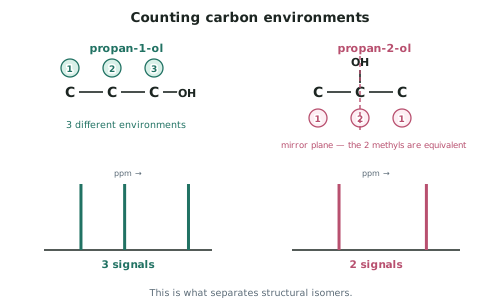
Why this is the isomer test
-
Structural isomers have the same molecular formula and often the same functional group, so mass spectrometry and IR cannot separate them.
-
They almost always have different symmetry, so they give different numbers of 13C signals.
-
This is what 13C NMR is for in this standard. Use the mass spectrum for size, the IR for the functional group, and the 13C for which isomer.
The signal count as a prediction
-
Work the other way as well: given a proposed structure, predict how many signals it should give, and check against the spectrum.
-
If your structure predicts four signals and the spectrum shows three, the structure is wrong — it is not symmetrical enough.
-
Predicting from a structure is explicitly allowed as an assessment task, so practise both directions.
What to notice: Three ¹³C signals — no symmetry. The m/z 31 peak (CH₂OH⁺) is the signature of a PRIMARY alcohol.
Compare propan-1-ol with propan-2-ol, or propanone with propanal, to see two molecules that no single technique can separate.
What 13C NMR does not tell you
-
Nothing about hydrogens. 13C looks only at carbon, so the number of hydrogens on each carbon is not directly visible.
-
Nothing about how many carbons are in each environment. In routine 13C spectra the peak heights are not proportional to the number of carbons, unlike 1H NMR integration. Two equivalent methyls give one peak, not a peak of double height.
-
Nothing about connectivity directly — you infer the skeleton from the count and the shifts, not from splitting.
-
Being clear about these limits is worth marks: an answer claiming to read the number of carbons from peak heights is using a technique that is not in this standard.
Worked ExampleDistinguishing isomers by signal count
Two compounds both have molecular formula C4H10O and both show a broad absorption at 3350 cm−1 in the IR with no absorption near 1700 cm−1. Compound X gives four 13C signals and compound Y gives two. Determine both structures.
Step 1 — Identify the functional group
A broad absorption at 3350 cm−1 is an alcohol O–H. The absence of anything near 1700 cm−1 confirms there is no C=O, so it is not a carboxylic acid.
Both compounds are alcohols.
Step 2 — List the possible structures
C4H10O as an alcohol has four structural isomers:
- Butan-1-ol, CH3CH2CH2CH2OH
- Butan-2-ol, CH3CH2CH(OH)CH3
- 2-methylpropan-1-ol, (CH3)2CHCH2OH
- 2-methylpropan-2-ol, (CH3)3COH
Mass spectrometry and IR cannot distinguish any of these — all have the same molar mass of 74 and the same functional group.
Step 3 — Predict the signal count for each
Butan-1-ol, CH3CH2CH2CH2OH: the four carbons are all different — the one bearing the OH, the one next to it, the next, and the terminal methyl. Four signals.
Butan-2-ol, CH3CH2CH(OH)CH3: the two methyl groups are not equivalent — one is attached to the CH(OH) and the other to a CH2. All four carbons differ. Four signals.
2-methylpropan-1-ol, (CH3)2CHCH2OH: the two methyl groups are equivalent by symmetry, so they give one signal; the CH and the CH2OH give one each. Three signals.
2-methylpropan-2-ol, (CH3)3COH: the three methyl groups are all equivalent, giving one signal; the central carbon gives another. Two signals.
Step 4 — Match to the data
Compound Y gives two signals, so it is 2-methylpropan-2-ol, (CH3)3COH — the only isomer with that much symmetry.
Compound X gives four signals, which matches both butan-1-ol and butan-2-ol. The signal count alone is not sufficient here.
Step 5 — Resolve compound X using chemical shifts
The shifts distinguish them. In butan-1-ol the C–O carbon is a primary carbon; in butan-2-ol it is a secondary carbon, more substituted and therefore further downfield.
- Butan-1-ol: the carbon bearing OH appears at about 62 ppm.
- Butan-2-ol: the carbon bearing OH appears at about 69 ppm.
A further piece of evidence is available from the mass spectrum: butan-1-ol shows a strong fragment at m/z 31 (CH2OH+), characteristic of a primary alcohol, while butan-2-ol shows a strong fragment at m/z 45 (CH3CHOH+) instead.
Answer: compound Y is 2-methylpropan-2-ol, (CH3)3COH, identified by its two signals arising from three equivalent methyl groups. Compound X is butan-1-ol or butan-2-ol, distinguished by the shift of the C–O carbon or by the m/z 31 fragment.