Using oxidation numbers to identify a redox reaction
Why oxidation numbers matter
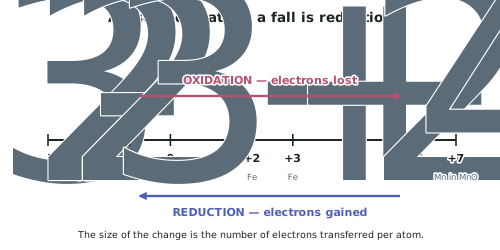
- Electron transfer is invisible. Oxidation numbers make it visible.
- Any atom whose oxidation number changes during a reaction has had electrons transferred to or from it.
- Rises → electrons lost → that atom was oxidised.
- Falls → electrons gained → that atom was reduced.
- Unchanged → spectator.
The three-step test
To decide whether a reaction is redox at all:
-
Assign oxidation numbers to every atom on both sides.
-
Compare each element's number before and after.
-
Conclude: if any number changed, it is a redox reaction. If none changed, it is not.
-
In a redox reaction there will always be at least one rise and at least one fall. A rise without a fall is impossible.
Reactions that are NOT redox
Recognising the non-redox cases saves you from over-applying the idea:
| Reaction type | Example | Why it is not redox |
|---|---|---|
| Neutralisation | H stays +1, O stays −2, Na stays +1, Cl stays −1 | |
| Precipitation | Ag stays +1, Cl stays −1; the ions just change partner | |
| Acid–carbonate | C stays +4 throughout |
- A useful shortcut: if no element appears as a free element on either side, and nothing changes its charge, it is probably not redox.
Reactions that always ARE redox
- Any reaction where an element appears free on one side and combined on the other.
- A free element has oxidation number 0, so it must have changed.
- — Zn goes 0 → +2, H goes +1 → 0.
- Combustion — the oxygen goes from 0 in O2 to −2 in the oxides.
- Displacement — a metal replaces a metal ion, or a halogen replaces a halide ion.
- Corrosion — iron goes from 0 to +3 in rust.
Counting the electrons transferred
-
The size of the change tells you how many electrons moved per atom.
- Cr going from +6 to +3 is a change of 3, so three electrons per chromium atom.
- Mn going from +7 to +2 is a change of 5, so five electrons per manganese atom.
-
Multiply by the number of atoms to get the total for a formula unit.
- In Cr2O72− there are two chromium atoms, so the whole ion gains 6 electrons.
-
This number is exactly the number of electrons you will need in the half equation, which is why doing this step first makes the half equations almost write themselves.
Worked ExampleDeciding whether a reaction is redox
For each of the following, state whether it is a redox reaction, and justify your answer using oxidation numbers.
(a)
(b)
Part (a) — assign the numbers
Reactants: Mg is a free element, so 0. In HCl, H is +1 and Cl is −1.
Products: In MgCl2, Mg is +2 and Cl is −1. H2 is a free element, so 0.
Now compare:
| Element | Before | After | Change |
|---|---|---|---|
| Mg | 0 | +2 | rise of 2 |
| H | +1 | 0 | fall of 1 |
| Cl | −1 | −1 | none |
Magnesium's number rises, so magnesium is oxidised and loses 2 electrons per atom. Hydrogen's number falls, so hydrogen is reduced and gains 1 electron per atom. Chloride is a spectator.
(a) is a redox reaction.
Part (b) — assign the numbers
Reactants: In BaCl2, Ba is +2, Cl is −1. In Na2SO4, Na is +1, O is −2, and sulfur must be +6 ().
Products: In BaSO4, Ba is +2, S is +6, O is −2. In NaCl, Na is +1, Cl is −1.
Every element has the same oxidation number on both sides. No electrons have been transferred — the ions have simply changed partners, and the reaction is driven by the barium sulfate being insoluble.
(b) is not a redox reaction; it is a precipitation reaction.