Assigning oxidation numbers
What an oxidation number is
- An oxidation number is a count of how many electrons an atom has gained or lost compared with the free element.
- A positive oxidation number means the atom has lost electron control.
- A negative oxidation number means it has gained electron control.
- Zero means it is unchanged from the free element.
- It is a bookkeeping device, not a real charge on the atom. Its only job is to let you spot which atoms changed during a reaction.
The rules, in the order you apply them
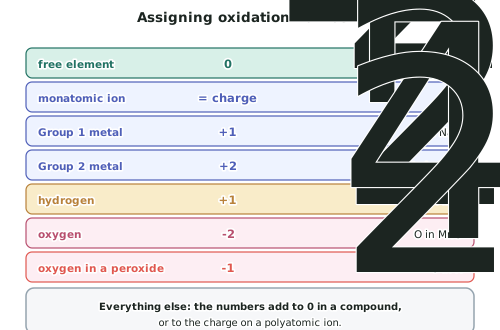
Apply these from the top down. When two rules disagree, the one higher in the list wins.
| Rule | Oxidation number |
|---|---|
| 1. Any atom in a free element | 0 — for Zn, Cl2, O2, S8, C |
| 2. A monatomic ion | equal to its charge — Na+ is +1, Cl− is −1, Fe3+ is +3 |
| 3. Fluorine in a compound | always −1 |
| 4. Group 1 metals in a compound | +1; Group 2 metals, +2 |
| 5. Hydrogen in a compound | +1 (except in metal hydrides such as NaH, where it is −1) |
| 6. Oxygen in a compound | −2 (except in peroxides such as H2O2, where it is −1) |
| 7. Everything else | worked out from the sum rule below |
The sum rule
This is the rule that actually does the work:
-
In a neutral compound, the oxidation numbers of all the atoms add up to 0.
-
In a polyatomic ion, they add up to the charge on the ion.
-
Multiply each element's oxidation number by how many of that atom there are before you add.
Working out an unknown
The method is always the same:
- Write the known oxidation numbers from the rules.
- Multiply each by the number of those atoms.
- Set the total equal to 0 (compound) or to the ion's charge (ion).
- Solve for the unknown.
For example, in MnO4−:
- Oxygen is −2, and there are four of them: .
- The total must equal the charge, −1.
- So , giving .
What is the oxidation number of Mn in MnO₄⁻?
- 1. Apply the rules. …
- 2. Use the sum rule. …
- 3. Solve. …
Watch out for these
- Oxygen is −2, except in peroxides. In H2O2 the oxygen is −1. You can spot a peroxide by the O–O bond, or by the arithmetic giving a nonsense answer for the other element.
- Charge is not the same as oxidation number. SO42− has a charge of −2 overall, but the sulfur in it has an oxidation number of +6 and each oxygen is −2.
- Oxidation numbers apply to atoms, not to groups. There is no single oxidation number for "the sulfate ion" — there is one for the sulfur and one for each oxygen.
- A fraction is possible but rare at this level. If you get one, re-check whether you have a peroxide or have miscounted the atoms.
Worked ExampleAssigning oxidation numbers in a dichromate ion
Determine the oxidation number of chromium in the dichromate ion, Cr2O72−.
Step 1 — Write down what the rules give you
Oxygen in a compound or ion is −2. There is no O–O bond here, so this is not a peroxide and the rule applies normally.
There are seven oxygen atoms:
Step 2 — Apply the sum rule
This is a polyatomic ion with a charge of −2, so all the oxidation numbers must add to −2.
Let the oxidation number of one chromium atom be . There are two chromium atoms:
Step 3 — Solve
Step 4 — Check it is sensible
Chromium in +6 is its highest common oxidation state, which fits: dichromate is a strong oxidant, and a strong oxidant is an element already stripped of as many electrons as it can be, ready to take them back.
Answer: each chromium atom in Cr2O72− has an oxidation number of +6.
Worked ExampleSpotting a peroxide from the arithmetic
Determine the oxidation number of oxygen in hydrogen peroxide, H2O2, and explain why the usual rule does not apply.
Step 1 — Apply the higher-priority rule first
Hydrogen sits above oxygen in the rule list, so hydrogen is fixed at +1. There are two hydrogen atoms:
Step 2 — Apply the sum rule
H2O2 is a neutral compound, so everything must add to 0. Let each oxygen be , and there are two of them:
Step 3 — Explain why
The usual value of −2 assumes each oxygen has taken electron control from two other atoms. In H2O2 the structure is H–O–O–H, so each oxygen is bonded to one hydrogen and one other oxygen. Two identical atoms share the bond electrons equally, so the O–O bond contributes nothing to either oxygen's oxidation number, leaving each oxygen at only −1.
Answer: each oxygen in H2O2 has an oxidation number of −1, because the O–O bond is between identical atoms and so contributes nothing to either atom's oxidation number.