Displacement reactions: metals and halogens
What a displacement reaction is
-
A displacement reaction is one where a more reactive species takes the place of a less reactive one.
-
Every displacement reaction is a redox reaction, because one species goes from free element to ion, and the other from ion to free element.
-
They are the clearest redox reactions to observe, because something visibly appears or disappears.
Metal displacement
- A more reactive metal will displace a less reactive metal from its compound.
- The more reactive metal is the better reductant — it gives up electrons more readily.
- What you see: the grey zinc strip dissolves and thins; a pink-brown coating of copper builds up on it; the blue colour of the solution fades.
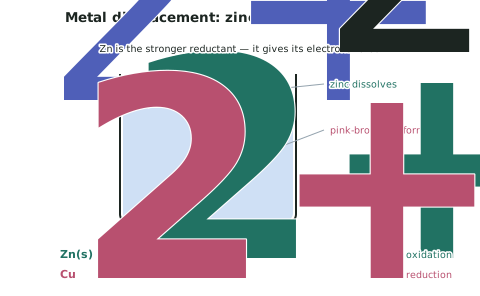
- Why it happens: zinc is the stronger reductant, so it hands its electrons to the Cu2+ ions. The reverse — copper metal in zinc sulfate — produces no change, because copper cannot force its electrons onto Zn2+.
Reading a reactivity order from experiments
-
If metal A displaces metal B from solution, then A is the stronger reductant.
-
If no reaction occurs, A is the weaker reductant. This negative result is real evidence, not a failed experiment.
-
Running every pair both ways round lets you build the whole order from observations alone — which is exactly the kind of task set for this internal.
| Experiment | Observation | Conclusion |
|---|---|---|
| Zn in CuSO4 | brown coating, blue fades | Zn is a stronger reductant than Cu |
| Cu in ZnSO4 | no change | confirms Zn > Cu |
| Mg in ZnSO4 | grey coating, Mg dissolves | Mg is a stronger reductant than Zn |
| Cu in AgNO3 | silver crystals, solution turns blue | Cu is a stronger reductant than Ag |
Halogen displacement
-
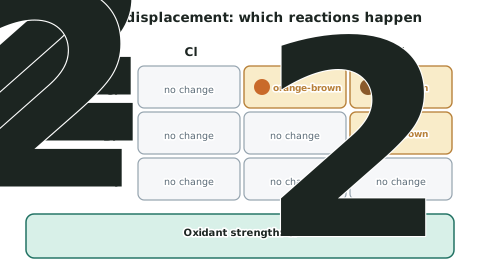
A more reactive halogen displaces a less reactive halide from solution.
-
Here the halogen is the oxidant, so the order runs the other way: the more reactive halogen is the stronger oxidant.
-
The order of oxidant strength is .
- What you see: the colourless bromide solution turns orange-brown as Br2 forms.
-
What you see: the solution turns brown as I2 forms.
-
The reverse reactions produce no change. Iodine cannot oxidise chloride or bromide.
Telling bromine and iodine apart
Both give brown-ish solutions, which is a real practical problem:
-
Starch turns blue-black with iodine, and does nothing with bromine.
-
Shaking with an organic solvent gives a purple layer with iodine and an orange layer with bromine.
-
If your assessment asks you to identify a brown product, a confirmatory test like this is what lifts the answer from a guess to a justification.
Worked ExampleBuilding a reactivity order from observations
A student places small pieces of three metals — X, Y and Z — into solutions of each other's nitrates. The results are:
- X in Y(NO3)2: a dark coating forms on X.
- X in Z(NO3)2: no change.
- Y in Z(NO3)2: no change.
Place the three metals in order from strongest to weakest reductant, and justify each placement.
Step 1 — Interpret the first result
X in Y(NO3)2 gives a coating, so a displacement occurred: X has given electrons to Y2+, depositing metal Y on the surface of X.
X was oxidised, so X is a stronger reductant than Y.
Step 2 — Interpret the second result
X in Z(NO3)2 gives no change. X was unable to give its electrons to Z2+, so Z is a stronger reductant than X.
This negative result is doing real work — without it, Z could not be placed at all.
Step 3 — Interpret the third result
Y in Z(NO3)2 gives no change, so Z is a stronger reductant than Y. This is consistent with what we already have, and confirms the order rather than adding to it.
Step 4 — Assemble the order
From step 2, Z > X. From step 1, X > Y. So:
Answer: Z is the strongest reductant, then X, then Y. Z gives up electrons most readily, which is why neither X nor Y can displace it from solution; Y gives them up least readily, which is why it is the only metal to be displaced.