Colours and appearances of the common redox species
Why observations carry the marks
-
Explanatory Note 4 lists "observations for reactions" as one of the six assessable things, and both Merit and Excellence require you to link your equations to what was seen.
-
An assessment will typically give you a table of substances with their appearances. It is not allowed to tell you which react together — so if you know the colours, you can work out what happened without the table.
-
Every colour change in this standard is a species being created or destroyed. Name the species, not just the colour.
The oxidants
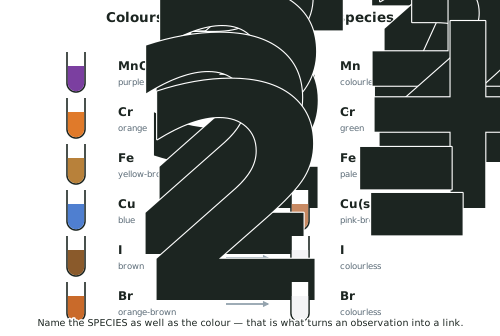
| Species | Appearance | Becomes | Appearance |
|---|---|---|---|
| MnO4− in acid | purple | Mn2+ | colourless (very pale pink) |
| Cr2O72− in acid | orange | Cr3+ | green |
| Fe3+ | yellow-brown | Fe2+ | pale green |
| Cu2+ | blue | Cu | pink-brown solid |
| I2 | brown in solution | I− | colourless |
| Br2 | orange-brown | Br− | colourless |
| Cl2 | pale yellow-green | Cl− | colourless |
| O2 | colourless gas | oxide / H2O | — |
| H2O2 | colourless | H2O | colourless |
| OCl− (bleach) | colourless | Cl− | colourless |
| IO3− | colourless | I2 | brown |
| conc. HNO3 | colourless | NO2 | brown gas |
| H+ | colourless | H2 | colourless gas, bubbles |
The reductants
| Species | Appearance | Becomes | Appearance |
|---|---|---|---|
| Metals | grey/silver solid (Cu is pink-brown) | metal ions | often colourless |
| Fe2+ | pale green | Fe3+ | yellow-brown |
| I− | colourless | I2 | brown |
| Br− | colourless | Br2 | orange-brown |
| H2S | colourless gas, rotten-egg smell | S | yellow solid |
| SO2 | colourless gas, choking smell | SO42− | colourless |
| SO32− / HSO3− | colourless | SO42− | colourless |
| H2O2 | colourless | O2 | colourless gas, bubbles |
| C | black solid | CO2 | colourless gas |
| H2 | colourless gas | H2O | colourless liquid |
Observations that are not colours
Do not stop at colour. These also count, and often they are the only observation available:
- Bubbles of gas — O2 from peroxide, H2 from a metal and acid, CO2 from carbon.
- A solid forming or disappearing — a metal coating on another metal, a yellow sulfur precipitate, a metal strip dissolving.
- A smell — rotten eggs for H2S, choking for SO2. (Never inhale deliberately; waft.)
- Heat — many redox reactions are strongly exothermic and the test tube warms.
- No change at all — which, as the halogen pages show, is itself evidence.
Writing an observation properly
- Say what changed, from what, to what.
- Weak: "It changed colour."
- Better: "The solution turned from purple to colourless."
- Best: "The purple MnO4− was decolourised as it was reduced to colourless Mn2+."
- The best version names the species as well as the colours. That is what turns an observation into a link, which is the Merit criterion.
Worked ExampleDeducing a reaction from observations alone
A colourless solution is added to an orange solution that has been acidified. The mixture turns green and a brown colour also develops. Using only the observations, identify the two species that reacted, state what happened to each, and write the overall equation.
Step 1 — Identify the orange solution
An orange solution in an acidified redox context is dichromate, Cr2O72−.
The mixture turning green identifies its product as Cr3+. Chromium has fallen from +6 to +3, so dichromate was reduced and is the oxidant.
Step 2 — Identify the colourless solution
The colourless solution must contain the reductant. A brown colour developing points to I2, which means the colourless solution contained iodide ions, I−.
Iodine has risen from −1 to 0, so iodide was oxidised and is the reductant.
Step 3 — Write the half equations
Step 4 — Combine
Multiply the iodide half by 3 so both involve 6 electrons, then add and cancel:
Step 5 — Check the observations against the equation
The equation predicts Cr3+ (green) and I2 (brown) as the coloured products, and the disappearance of the orange Cr2O72− — which is exactly the sequence described.
Answer: acidified dichromate (orange) was reduced to Cr3+ (green) and acted as the oxidant; iodide (colourless) was oxidised to I2 (brown) and acted as the reductant.