Electron transfer: oxidation, reduction, oxidants and reductants
What a redox reaction is
- A redox reaction is one in which electrons are transferred from one species to another.
- The two things happen at the same time and in the same amount. You cannot have one without the other.
- Electrons do not float about loose in a beaker. Every electron lost by one species is gained by another in the same instant.
Oxidation and reduction
- Oxidation is the loss of electrons.
- Reduction is the gain of electrons.
The memory hook is OIL RIG:
- Oxidation Is Loss (of electrons)
- Reduction Is Gain (of electrons)
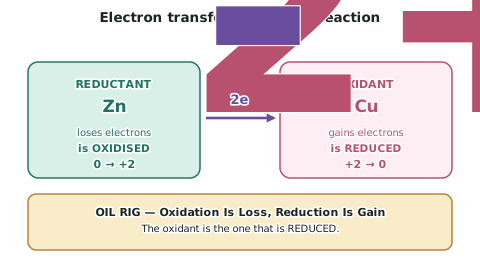
Oxidants and reductants
This is where students most often go wrong, because the names feel backwards.
- The oxidant (oxidising agent) is the species that causes oxidation in something else — so it must gain the electrons. The oxidant is itself reduced.
- The reductant (reducing agent) is the species that causes reduction in something else — so it must give away the electrons. The reductant is itself oxidised.
| Species | What happens to it | What it does to the other species | Electrons |
|---|---|---|---|
| Oxidant | Is reduced | Oxidises the other species | Gains them |
| Reductant | Is oxidised | Reduces the other species | Loses them |
- Think of it as a transaction: the reductant is the giver, the oxidant is the taker.
Reading electron transfer from a half equation
- A half equation shows one half of the transfer, with the electrons written in.
- Electrons on the right means electrons are being lost → that half equation is the oxidation.
- Electrons on the left means electrons are being gained → that half equation is the reduction.
For example:
- Electrons on the right, so Fe2+ is oxidised. Fe2+ is acting as the reductant.
- Electrons on the left, so Cl2 is reduced. Cl2 is acting as the oxidant.
Counting electrons
- The number of electrons in a half equation tells you how many are transferred per particle.
- transfers two electrons per copper ion.
- transfers one electron per iron ion.
- When you combine two half equations, the electron numbers must match. If they do not, multiply one or both half equations until they do. This is covered in full later in this topic.
Worked ExampleIdentifying oxidant and reductant
Acidified potassium permanganate solution is added to a solution of iron(II) sulfate. The purple colour disappears and the pale green solution turns yellow. Identify the oxidant and the reductant, and explain your choice in terms of electron transfer.
Step 1 — Identify the species that actually change
The two species that change are MnO4− (purple) and Fe2+ (pale green). The K+ and SO42− ions are spectators — their oxidation numbers do not change.
Step 2 — Work out what happened to each
The purple MnO4− is decolourised, which means it became Mn2+ (colourless). Manganese goes from an oxidation number of +7 in MnO4− down to +2 in Mn2+.
- The oxidation number falls, so manganese gained electrons: MnO4− is reduced.
The pale green solution turned yellow, which means Fe2+ became Fe3+. Iron goes from +2 up to +3.
- The oxidation number rises, so iron lost an electron: Fe2+ is oxidised.
Step 3 — Put the names on
- MnO4− is reduced, so MnO4− is the oxidant — it took the electrons and caused the iron to be oxidised.
- Fe2+ is oxidised, so Fe2+ is the reductant — it gave up the electrons and caused the permanganate to be reduced.
Answer: MnO4− is the oxidant (it is reduced from Mn +7 to Mn +2 by gaining 5 electrons); Fe2+ is the reductant (it is oxidised from Fe +2 to Fe +3 by losing 1 electron).